
Back in the summer of 1971, President Nixon shocked the world when he announced the U.S. dollar would no longer be backed by gold.
It was the end of the Bretton Woods system… and the end of an era.
From 1944 until 1971, world currencies were tied to the U.S. dollar. Foreign banks could then exchange their dollars for gold at $35 per ounce.
This system worked for decades to stabilize global currencies… but eventually, the amount of U.S. dollars in circulation began to exceed U.S. gold reserves. This became especially problematic as foreign nations became skeptical of the dollar’s value—and the U.S.’s ability to meet its obligations.
In short, countries around the world began clamoring for gold—depleting half of our nation’s gold reserves… and putting the U.S. at risk of a “gold run.”
At the same time, we were dealing with unprecedented inflation. In an effort to stem both of these issues, the Nixon Administration enacted a drastic new economic policy—which included ending the dollars-for-gold global exchange system.
After Nixon got rid of the gold standard, the limits on the price of gold were removed… allowing the yellow metal to soar as investors sought a safe haven.
Over the course of the decade, gold beat all other major assets… And by the end of the 1970s, the price of gold was up more than 1,000%.
This makes sense—gold has long been the go-to safe investment during economically uncertain times.
So it also makes sense that the yellow metal languished once the economy stabilized in the ’80s… before drifting down to its eventual low in 1999.
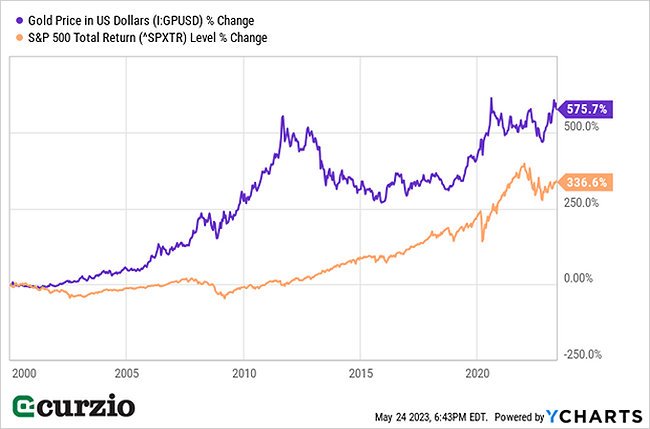
Since then, it’s up nearly sevenfold.
In fact, gold—an old-school, non-dividend-paying, unproductive asset—has outperformed the S&P 500 by a wide margin so far this century (as you can see below).And now, it’s getting ready for another bull run.
Today, we’ll look at why… and I’ll share a simple way to take advantage of the situation.
One of the best ways to protect your assets in today’s economy
If you’re struggling with today’s stubborn inflation… you’re not alone.
In a recent Gallup poll, inflation was mentioned more than three times as often as any other problem… with 35% of Americans calling it their family’s top financial concern.
It makes sense, considering we’re currently seeing some of the highest inflation levels since the Nixon Administration 50 years ago.
Yes, inflation has come down off its 40-year highs… and is no longer approaching double digits. But the problem is far from over.
In fact, the Consumer Price Index (CPI) has been rising at an average of 5% for the past three years. This translates to a cumulative total of over 18%. In other words, what cost you $100 in April 2020 would now cost you $118.32 (as of April 2023).
That’s bad news for consumers… But it’s good news for gold.
Persistent inflation, market declines, and economic distress all work in gold’s favor as investors clamor for a reliable way to preserve the value of their money.
We saw this play out in the inflationary era of the ’70s—and several times more recently…
During the COVID pandemic (and resulting recession) of 2020, gold broke out to a new all-time high, hitting an intraday price of over $2,089 per ounce.
During the bear market of 2022, gold was the only major asset to post positive performance—adding 0.4% last year while the stock market lost more than 18%.
And this year, investors flocked to gold in the wake of the banking crisis… pushing the yellow metal back towards its COVID-era levels. It’s currently trading just a few percent below its all-time highs.
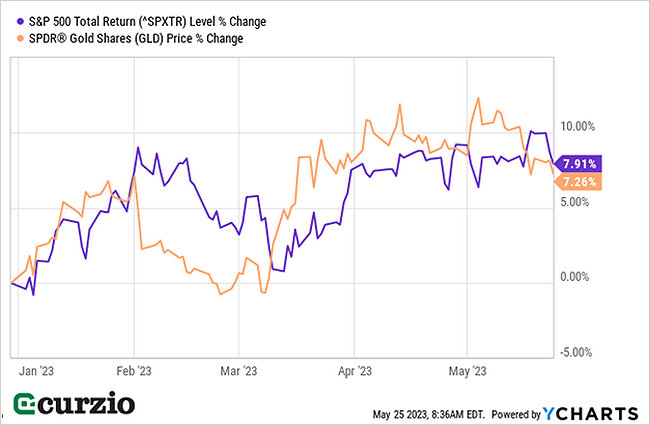
Gold’s outperformance has faded a bit over the past month as the stock market rallied off its lows and inflation showed some signs of abating. But it’s still up about 7% for the year, as you can see on the chart below.And it’s got way more upside ahead.
As investors prepare for a coming recession, they’ll increasingly look to gold to preserve their wealth—and make money—even in the worst economic conditions.
In short, gold is about to get a boost in demand as investors look for a safe place to park their assets and protect their purchasing power.
One convenient way to play gold’s upside is with SPDR Gold Shares (GLD), a popular exchange-traded fund (ETF) that tracks the precious metal’s performance. When gold goes up, so will this fund. And because it’s an ETF, it’s as easy to buy and sell as a stock.
Conclusion
With its millennia-long history of reliably storing value, gold remains a great way to protect your wealth against economic uncertainty. It’s one of the best defenses against inflation known to man… and one of the safest assets you can buy.
And with sticky inflation and an inevitable recession ahead, it’s set to rise even higher from here.
If you don’t have exposure, now’s the time to get it. And one of the simplest ways to do that is with GLD.
Genia Turanova, CFA, has more than two decades of Wall Street experience, and has served as an editor and chief investment strategist for multiple investment advisories. In 2019, Genia brought her proven investment record to Curzio Research as the lead analyst and editor behind Moneyflow Trader and Unlimited Income.
P.S. For more of my favorite assets for this perilous market—from precious metals and consumer goods to energy and healthcare—make sure to join us at Unlimited Income.Sign up today—risk-free.
Read the signs. Beat the market.
The market intelligence you need to invest one step ahead. Go beyond the headlines. Invest with an insider’s edge.
The U.S. is tightening sanctions on Iran's oil network. But Iranian barrels are still moving through China and a shadow fleet of tankers, shell companies, and middlemen. Here's why that fragile workaround system matters for crude prices—and energy stocks.
Oil’s sustained price is a major indicator that few are watching. If crude stays elevated, it could keep inflation sticky, limit the Fed’s flexibility, squeeze corporate margins, and shift market leadership. Here’s how to position your portfolio.
Our biases can lead to costly investment decisions. But one simple strategy can help you overcome biases by minimizing the "guesswork" in your portfolio… and automatically turn market declines to your advantage.
Total addressable market (TAM) is the key to finding the market's next big winners. Here's why TAM matters more than traditional metrics—and how investors can spot companies with massive growth potential before the crowd catches on.
Nobel Prize-winning economist Daniel Kahneman spent his career studying cognitive biases in investing… and how they can lead to costly mistakes in the market. Genia shares a simple strategy to remove bias from your investment decisions.

Last week, social media giant Reddit (RDDT) and AI infrastructure company Astera Labs (ALAB) both IPOed—and hit the market running. Genia explains why the successful IPOs are huge news for the entire IPO sector… and shares 3 ways to profit.
In the past few years since its widespread release, 5G has quickly become a critical technology across industries. Genia shares how 5G is transforming the tech landscape… and an ideal stock to profit as the trend unfolds.
Walmart (WMT) is trading near all-time highs—but it has way more room to run, thanks to several long-term tailwinds. Better yet, its recent stock split opens up a new pool of investors.
Inflation isn't over yet. In fact, in his recent interview on CBS’s 60 Minutes, Fed Chair Powell asked for public patience and admitted that interest rates might be staying higher for longer. Here are 3 investment strategies to prepare for…
One tech leader offers investors exposure to the AI megatrend… without the sky-high premiums attached to the market's leading stocks. And investors get to collect a market-beating dividend as they wait for the upside to play out.
Iran reportedly suspended indirect talks with the U.S. and is threatening to completely block the Strait of Hormuz. That matters because roughly 20% of the world's oil flows through this narrow chokepoint. Here's what it means for oil prices, energy…
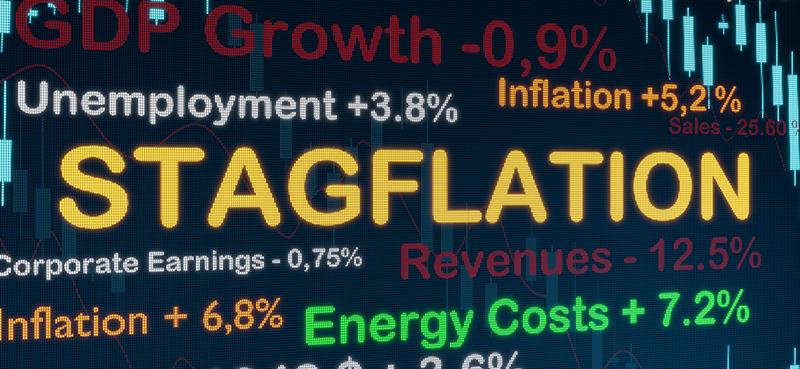
The latest economic data has revived fears of stagflation—a painful mix of weak growth and stubborn inflation. But today's economy isn't the 1970s. Here's what the numbers actually say… and what investors should watch next.
AI is this century's gold rush—and the biggest fortunes will once again go to the companies selling the "shovels." These seven sectors are providing the energy and infrastructure to power the AI boom.
War-risk insurance premiums on Strait of Hormuz transits have surged from pre-war levels, and shipping traffic has collapsed by roughly 95%. Here's how insurers are controlling oil transit… and what it means for your portfolio.
The Trump administration plans to drop $2 billion on nine quantum computing companies in exchange for equity stakes. IBM (IBM) gets the biggest slice, but the pure-play names are seeing the real upside. Here's what this signal means for investors.
President Trump's Beijing summit with President Xi produced few clear-cut answers on important geopolitical topics. But beneath Trump's ambiguous comments are five important signals investors should watch.
The market thought AI spending had peaked. Big Tech earnings just proved otherwise. With CapEx accelerating and demand surging, the opportunity is expanding. Here's what the numbers reveal—and where investors should be looking next.