

Here’s how the money breaks down
IBM (IBM) is set to get the biggest check: $1 billion (roughly half the entire package) to support Anderon, a new standalone company focused on quantum wafer manufacturing. Semiconductor manufacturer GlobalFoundries (GFS) comes in second at $375 million. The remaining companies, including D-Wave Quantum (QBTS), Rigetti Computing (RGTI), and Infleqtion (INFQ), are poised to each receive $100 million. The one exception is startup Diraq, which is slated for $38 million. The market reaction was immediate. IBM rose more than 4.6% after the open, while GlobalFoundries surged roughly 12%. But the pure-play quantum names went ballistic: D-Wave jumped nearly 20%, Rigetti climbed over 22%, and Infleqtion led the entire group, surging more than 36% in a single session. That kind of move in the smaller names tells you something important: Wall Street wasn’t pricing in this level of government commitment to the sector.Why is the government doing this now?
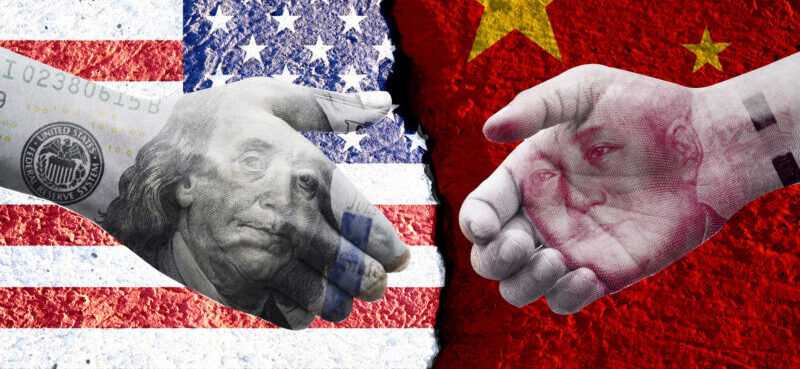
One word: China. Beijing has been pouring resources into quantum technology for years. China’s quantum industry reportedly reached 11.56 billion yuan in 2025, with annual growth rates exceeding 30%. And the Chinese Communist Party has already earmarked quantum technology as one of the key emerging technologies in its upcoming 15th Five-Year Plan covering 2026–2030. The U.S.-China race for quantum supremacy isn’t hypothetical anymore. It’s a live competition… and whoever gets there first gains an enormous advantage in cryptography, national security, financial modeling, and drug discovery. The Trump administration is essentially saying: We’re not going to let China win this one. The government’s equity stake is the tell. This isn’t charity. The administration wants upside, which means it expects these companies to succeed.Here’s where things get interesting
The broader quantum computing market is still in its early stages. One estimate puts the global quantum computing market at ~$3.52 billion in 2025. And it’s projected to reach $20.20 billion by 2030. That’s a compound annual growth rate (CAGR) of around 41.8%. Another firm pegs the U.S. market alone to grow from $0.97 billion in 2025 to $4.59 billion by 2030—a 36.4% CAGR. Those growth rates are extraordinary. And now you have the federal government directly funding the companies building the infrastructure to get there. And when Washington deems a sector critical to national security, funding doesn’t stop at a single round. Think about what happened to defense contractors after 9/11. Or semiconductor manufacturers after the CHIPS Act. Policy bets tend to create durable tailwinds.The bottom line
This $2 billion announcement is important for two reasons. First, it validates the entire quantum computing sector at a level we haven’t seen before. When the U.S. government takes equity, it’s doing due diligence. That de-risks the narrative for institutional investors who have been sitting on the sidelines waiting for a credibility signal. Second, it creates a strong tailwind for the pure-play names. Rigetti, D-Wave, and Infleqtion are still small companies. But being a government-backed equity story changes your fundraising ability, contracts pipeline, and staying power. IBM is the safe play here. $1 billion in fresh federal capital is being allocated to a new quantum venture inside one of the most recognized tech brands on the planet. And GlobalFoundries brings the hardware manufacturing piece that the entire ecosystem needs to scale. But if you want asymmetric upside, the pure-play names are where the market is clearly looking. Watch how this evolves. The government rarely writes just one check in a sector it considers strategic. If quantum keeps delivering technical milestones—and the geopolitical pressure from China intensifies—this $2 billion could look like the opening bid. Want more deep-dive insights into what’s moving the markets—and how to position your portfolio? Start your Wall Street Unplugged membership today.Curzio Research publishes market commentary for informational and educational purposes. The opinions expressed and market conditions when the content is published may change. It is not personalized investment advice or an offer to buy or sell securities. Investing involves risk, including possible loss of principal. Do your own research and consult a qualified investment professional before making investment decisions.