
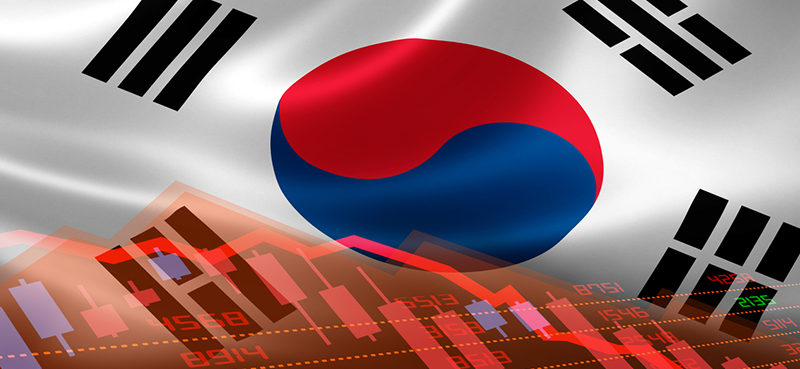
Seoul opened Tuesday and didn’t stop falling.
South Korea’s KOSPI index plunged 10.5% in a single session—its worst single-day decline in more than three months.
It was bad enough to trigger a circuit breaker—an automatic market-wide trading halt designed to slow panic-selling before it feeds on itself. It’s a mechanism you don’t often see activated.
This was the third time the KOSPI triggered one in 2026 alone.
By the time U.S. futures opened, the Nasdaq-100 had extended losses to nearly 3%, with the broader tech sector dragging the S&P 500 lower alongside it. The Nasdaq shed roughly $1 trillion in market cap over the course of the session.
So what actually happened? And what does it mean for your portfolio?
The catalyst: Two stocks that are basically the whole index
The KOSPI moves when Samsung Electronics and SK Hynix move. Those two names account for the bulk of the index’s weighting and nearly all of its gains over the past year.
On Tuesday, Samsung fell 10.2%, and SK Hynix dropped 7.7%.
The moves came after reports surfaced that SK Hynix was slowing its HBM4 expansion and shifting resources back toward conventional DRAM output.
HBM—high-bandwidth memory—is the specialized chip architecture that makes AI model training possible. It’s what Nvidia (NVDA) needs in enormous quantities to run its flagship data center processors.
So when the market heard that SK Hynix was pulling back from HBM4 development, investors didn’t wait around to hear why.
Compounding that, concerns emerged around AI competitiveness following leadership departures at Google, adding another layer of uncertainty to the AI spending narrative that has powered the entire chip trade for the past two years.
Together, those two headlines were enough to crack a market that had already been stretched to record highs.
Why a selloff in Seoul hits your Nasdaq holdings
The connection is direct. Samsung and SK Hynix supply the memory chips that flow into Nvidia’s data center products, which in turn power the AI buildout at Microsoft, Amazon, Meta, and Google. The global AI supply chain is tightly linked: Seoul, Taiwan, Santa Clara, and Seattle are all one trade.
When investors start questioning whether AI demand can sustain the pace of spending priced into these stocks, the selling cascades down the supply chain into the Nasdaq.
That’s the pattern 2026 has established: sharp AI-led drawdowns, partial recoveries, repeat. Tuesday was the third major tremor of that kind this year.
What this actually tells you
One bad day in Seoul doesn’t end a bull market. But it does expose something worth understanding: the AI trade is highly concentrated, and the valuations priced into it leave very little room for doubt.
Samsung and SK Hynix briefly pushed their combined market cap toward $1 trillion during the rally’s peak.
When a report surfaces suggesting one of them is slowing a key product line, that much concentration means the selloff is fast and steep. In other words, when a handful of names carry most of the index’s weight, bad news for one shakes the whole market.
The U.S. market faces the same concentration risk. Nvidia, Microsoft, and a handful of other names carry an outsized share of the Nasdaq’s total value. When sentiment shifts on AI, those names move hard.
That doesn’t make them bad investments. It means position sizing and diversification actually matter right now. That’s how you stay in the game through days like Tuesday without being forced to sell at the worst moment.
What to watch from here
The most important signal over the next few sessions is whether SK Hynix clarifies its HBM4 plans.
If the company confirms it’s pulling back from next-generation AI memory at scale, that’s a real story with real consequences. It would mean a reduced supply of the chips Nvidia needs to keep its data center business growing, and that shortfall would ripple through every company spending heavily on AI infrastructure.
If it’s a misread or a reallocation within the same budget envelope, this selloff will likely retrace quickly.
Watch Nvidia closely as well. Any commentary from Nvidia about its memory supply chain—whether at its shareholder meeting this week or in analyst briefings—will matter more than almost any macro headline right now.
Tuesday was a sharp reminder that the AI trade is still fragile at the edges. The long-term demand for AI infrastructure isn’t in question. The pace, sequencing, and valuations stacked on top of that demand are still being negotiated in real time.
Stay selective. Prioritize companies with real contracts and real cash flow, not just AI adjacency. And keep some dry powder ready, because volatile days like this one have a way of creating better entry points than you’d find in calmer markets.
For more deep-dive analysis into what’s moving the markets—and specific stock recommendations to play the latest trends—check out our new service, Curzio Alpha.
Curzio Research publishes market commentary for informational and educational purposes. The opinions expressed and market conditions when the content is published may change. It is not personalized investment advice or an offer to buy or sell securities. Investing involves risk, including possible loss of principal. Do your own research and consult a qualified investment professional before making investment decisions.