

Equity investors have celebrated Big Tech’s enormous AI spending plans.
Bond investors are starting to question how much of that spending they will be asked to finance… and what return they should demand for doing it.
Goldman’s FICC desk—the division that trades fixed income, currencies, and commodities—put out a note, which included this key line:
It is hard to remember a larger disparity between price and sentiment within IG [investment-grade] credit… the messaging from credit investors is increasingly clear that it will be very difficult to fund another $360 billion in the next 12 months in the same manner.
Simply put, while bond prices remain relatively strong, the investor enthusiasm underneath those prices has weakened… and the market may struggle to absorb another enormous wave of issuance unless borrowers offer better terms.
Bear in mind that investment-grade bonds are the highest-quality corporate debt, issued by companies with strong balance sheets and reliable earnings.
This is supposed to be the boring, safe corner of the market… So when Goldman says sentiment is deteriorating fast, it’s worth paying attention.
The size of what’s being financed is staggering
Microsoft (MSFT), Amazon (AMZN), Alphabet (GOOGL), and Meta (META) are on track to spend roughly $725 billion combined on capital expenditures in 2026—up about 77% from $410 billion last year.
And Goldman Sachs analysts estimate that hyperscaler capital spending in 2026 is running at roughly 100% of operating cash flows. In other words, these companies’ combined capital spending is roughly equal to every dollar they generate from operations.
Maintaining this pace means there’s less internally generated cash available for buybacks, dividends, acquisitions, and other priorities… making external financing increasingly important.
And that’s where the bond market comes in.
But here’s the problem… Hyperscalers have already sold an estimated $194 billion in AI-related bonds in 2026. At the current pace of spending, they may need hundreds of billions more in external financing over the next year. Global AI debt issuance is already projected to reach nearly $570 billion for 2026, almost four times the 2022 total.
But the bond market has a limit on how much it’s willing to lend at current yields… and the industry may be approaching it faster than anyone expected.
Amazon’s bond deal told the story in real time
Amazon just completed a $25 billion bond sale—one of the largest corporate debt deals in recent memory.
Investors initially placed about $62 billion in orders for the sale. But as strong early demand allowed Amazon to reduce the yield it was offering, some buyers pulled back, leaving roughly $41 billion in final orders.
The deal still attracted more demand than bonds available. But the retreat showed that investors were highly sensitive to the price: Many investors wanted more yield to participate than Amazon wanted to pay.
The bonds weakened in secondary trading after the deal priced, alongside the broader hyperscaler bond complex.
The key takeaway: The bond market is becoming more selective in funding more hyperscaler debt.
Why equity investors should care about a bond market problem
The bond and stock markets must talk to each other sooner or later.
If credit investors start demanding significantly higher yields to absorb hyperscaler debt, that raises the cost of funding the AI buildout.
Higher borrowing costs reduce the expected returns on those massive data center investments. And if returns fall far enough, companies may begin revisiting the pace or scale of their capital spending plans.
A slowdown in AI spending would flow directly into semiconductors, data center hardware, power infrastructure, and the entire ecosystem of companies built around serving the buildout.
To be clear: Goldman isn’t calling a collapse. And the hyperscalers aren’t suddenly in financial distress. Microsoft, Amazon, Alphabet, and Meta generate hundreds of billions in operating cash flow each year. These are not speculative companies borrowing against a dream.
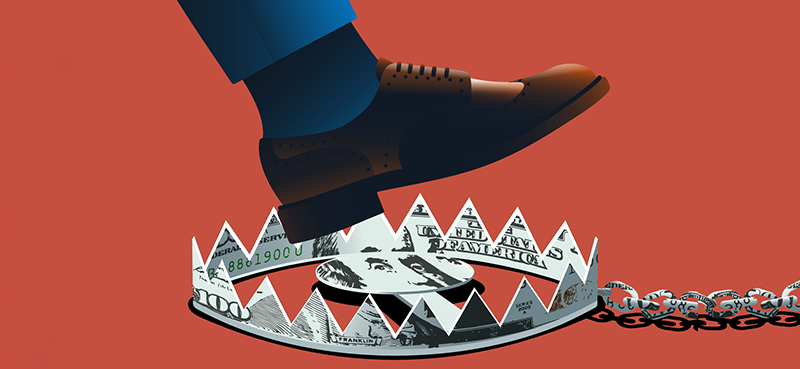
The concern is the pace and scale of borrowing relative to what the market can absorb. The bond market is essentially saying, “Slow down, or pay more.”
Bottom line
Equity investors have spent the better part of two years pricing AI infrastructure spending as a pure positive. Every dollar of capex was treated as proof that the future was arriving on schedule.
But the bond market is starting to ask who picks up the tab.
Credit markets tend to be early, and they’re flashing caution right now. Equities aren’t fully pricing that in yet… but that gap rarely stays open for long.
For more on how to position ahead of the next big market shift, stay tuned to Wall Street Unplugged, delivered straight to your inbox each week.
Curzio Research publishes market commentary for informational and educational purposes. The opinions expressed and market conditions when the content is published may change. It is not personalized investment advice or an offer to buy or sell securities. Investing involves risk, including possible loss of principal. Do your own research and consult a qualified investment professional before making investment decisions.