
The number Wall Street had been dreading finally showed up in black and white.
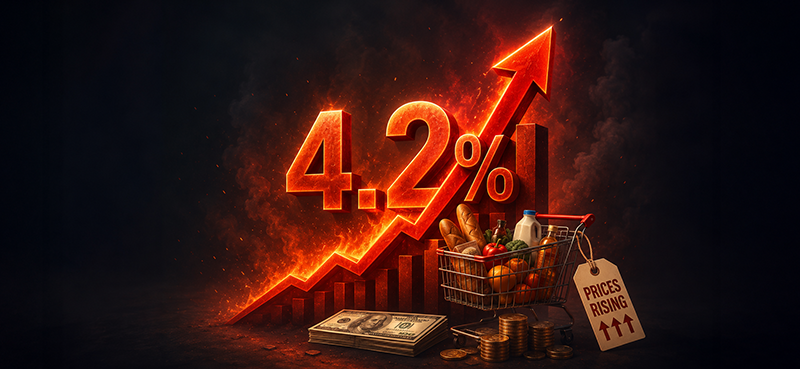
U.S. inflation climbed to 4.2% in May, the highest annual reading in more than three years and up sharply from 3.8% in April.
The news comes at a moment when the Federal Reserve was supposed to be winding down its battle with rising prices, not fighting a second round.
To make the picture more complicated: the economy isn’t weakening. Q1 GDP was revised up to 2.1%, real consumer spending rose 0.3%, and the labor market hasn’t cracked.
In other words, this isn’t inflation born from a panicking economy. Demand is holding up, and prices are still climbing.
That combination of strong growth and persistent inflation puts the Fed in a difficult spot.
What the Fed just said
At its June 17 meeting, the Federal Open Market Committee held the federal funds rate at 3.50%–3.75% for the fourth consecutive meeting.
Holding steady was the expected move. But the language around that decision shifted noticeably.
The Fed’s median projection for the funds rate at year-end is now 3.8%, up from 3.4% in March. That’s the committee signaling that at least one rate hike is likely before December. It also revised its 2026 headline inflation forecast to 3.6%—up dramatically from the 2.7% projection it published just three months ago.
Simply put, the Fed is acknowledging that the inflation story changed faster than it expected… and it’s now preparing the market for the possibility of rising rates.
Why this matters for your money
Earlier this year, market expectations were tilted toward one or two rate cuts in 2026. Those expectations have now flipped: Wall Street is pricing in one to two hikes instead.
That’s a meaningful shift with real consequences across asset classes.
For bond investors, rising rates mean falling bond prices. When new bonds are issued at higher yields, the older ones with lower yields become worth less.
Longer-duration bonds (those that don’t mature for 10 or 20 years) feel this the most. If you’re holding long-duration Treasuries expecting a rate cut rally, the May inflation print just put that trade under significant pressure.
For equity investors, the impact is more nuanced but still real.
Higher rates raise borrowing costs for companies, slow consumer credit, and put pressure on valuations—especially for growth stocks priced on future earnings. Sectors that carry heavy debt loads or rely on cheap capital to fund expansion face the steepest headwinds.
On the other side, some parts of the market actually benefit. Banks and financial companies like JPMorgan Chase (JPM) and Bank of America (BAC) tend to earn wider net interest margins—the difference between what they pay depositors and what they charge borrowers—when interest rates rise.
And cash itself finally pays again: Money market funds and short-term Treasuries are offering real returns for the first time in years.
The detail buried in the headline number
One thing worth noting: Core CPI, which strips out volatile food and energy prices, rose 2.9% year-over-year in May. That’s still above the Fed’s 2% target, but it’s meaningfully lower than the headline 4.2% print.
The gap between those two numbers tells you a lot. Energy prices—which are being driven in large part by the Iran conflict and supply disruptions—are doing a significant amount of the heavy lifting on headline inflation. Strip them out, and the underlying inflation picture, while still too hot for the Fed’s comfort, isn’t as alarming.
That matters because energy-driven inflation is harder for the Fed to fix with interest rates. You can’t rate-hike your way to cheaper oil. The Fed knows that, which is why it’s moving carefully rather than aggressively.
It’s also why every development in global energy markets between now and year-end will carry as much weight as any economic data release.
What to watch from here
The July CPI report will be the next major test. If inflation starts to roll back toward 3.5% or below, the Fed gets a reason to pause and reassess. If it holds above 4%, the case for a hike before year-end becomes harder to argue against.
Watch consumer spending closely, too. The 0.3% rise in real spending in May indicates that households remain active. But higher prices erode purchasing power over time. If inflation stays elevated while wages don’t keep pace, spending will likely soften—and with it, the growth that’s been keeping recession fears at bay.
Bottom line
The inflation story isn’t over. May’s 4.2% reading closed the door on the rate cut narrative that dominated the first half of the year, and the Fed’s own projections are now pointing in the opposite direction.
Stronger GDP growth and resilient consumer spending mean the economy can absorb tighter policy for now, but the margin for error is shrinking.
Stay selective. Favor quality companies with real pricing power and strong balance sheets. Keep duration short on the bond side. And watch the energy markets; right now, they’re writing the inflation script more than anything the Fed says.
For deeper analysis on how to position through a higher-for-longer rate environment—including specific stock picks—check out our new service, Curzio Alpha.
It’s an all-in-one investing hub that gives you access to all our market research and stock recommendations—under a single portfolio.
Learn more to see if Curzio Alpha is right for you.
Curzio Research publishes market commentary for informational and educational purposes. The opinions expressed and market conditions when the content is published may change. It is not personalized investment advice or an offer to buy or sell securities. Investing involves risk, including possible loss of principal. Do your own research and consult a qualified investment professional before making investment decisions.