
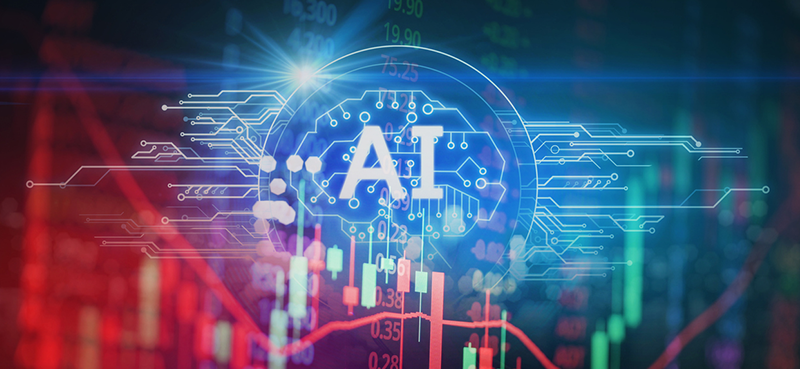
Over the past several weeks, some of the market’s strongest AI companies have reported exactly what investors supposedly wanted to see:
Rapid revenue growth, record demand, expanding backlogs, and billions of dollars in new contracts.
Their stocks fell anyway.
Then, almost as suddenly, many of those same stocks exploded higher.
When stocks rise or fall that quickly without a corresponding change in the business, something else is usually happening beneath the surface.
In this case, a major part of the answer appears to be leverage.
Simply put, a highly concentrated, heavily leveraged AI trade began unraveling. The resulting margin calls and forced liquidations placed additional pressure on some of the market’s most crowded stocks.
The result was a chain reaction that temporarily overwhelmed company fundamentals… and turned an ordinary correction into one of the most violent rotations the AI trade has experienced.
The first major signs appeared in South Korea
South Korea became one of the world’s hottest stock markets as investors rushed into Samsung Electronics and SK Hynix—two companies at the heart of the AI memory-chip boom.
Those companies grew to represent an enormous share of the Korean market, leaving the broader KOSPI increasingly dependent on the performance of just two stocks. The Bank of Korea warned in early July that leveraged exchange-traded funds (ETFs) tied to Samsung and SK Hynix could deepen that concentration and amplify volatility.
The concern centered on products designed to deliver approximately twice the daily return of the underlying stock.
That works extremely well when prices are rising. A 5% gain in the stock can produce a roughly 10% gain in a 2x leveraged product.
But the same math works in reverse.
And because leveraged products must regularly rebalance their exposure, large market moves can force them to buy into rallies and sell into declines… adding momentum to whichever direction the market is already moving.
Once Samsung and SK Hynix began falling, the leveraged products magnified the damage. The broader Korean market experienced repeated circuit breakers and extraordinary daily swings as the global semiconductor selloff spread.
By the end of July, the KOSPI had fallen approximately 30% from its June peak. It then surged roughly 18% in a single session, while Samsung and SK Hynix posted enormous one-day rebounds.
That is far from normal price discovery.
It’s what a market looks like when leverage is rapidly unwinding—and then reversing—in both directions.
The same stocks appeared in a crowded U.S. trade
The Korean market was only one part of the story.
Many of the same AI themes were also concentrated inside one of Wall Street’s fastest-growing hedge funds.
Situational Awareness was founded by Leopold Aschenbrenner, a former OpenAI researcher who became one of the most closely watched investors in the AI trade.
The fund’s performance had been extraordinary. It reportedly grew from a few hundred million dollars to $45 billion at its peak after producing enormous gains from concentrated and leveraged investments tied to AI.
Its public positions reportedly included companies exposed to AI infrastructure, memory chips, data centers, and power—the same areas that had produced some of the market’s largest gains.
But those returns were amplified by borrowed money.
The fund reportedly used financing arrangements that allowed it to gain substantially more market exposure than its available capital would ordinarily support.
One vehicle that can create this kind of exposure is a total return swap.
In a simplified example, a bank owns or purchases a stock while a hedge fund receives the stock’s economic return. The fund pays the bank a financing rate and fee rather than paying the stock’s entire purchase price.
The fund therefore gains exposure to the security without technically owning the underlying shares.
That structure can generate spectacular returns while the stock rises… But it becomes considerably more dangerous when several large holdings fall together.
An investor who owns a stock outright can usually wait through a 30% decline if the company’s long-term thesis remains intact.
A heavily leveraged fund may not have that choice. As the value of its holdings falls, lenders can demand additional collateral. If the fund can’t provide enough cash, it must reduce its positions… or allow the lender to liquidate them.
That’s a margin call.
Once several large positions generate margin calls simultaneously, a fund may be forced to sell its strongest assets along with its weakest ones simply to raise cash.
That appears to be what happened to Situational Awareness.
The fund reportedly lost 67% in July as its AI holdings declined. It subsequently sold a large portion of its public portfolio to Citadel to meet margin calls and eliminate its leverage.
The forced reduction helps explain why several AI-linked stocks experienced selling that appeared disconnected from their operating performance.
Why strong earnings couldn’t stop the selling
This brings us to one of the market’s biggest mysteries:
Why did so many AI stocks fall despite reporting strong earnings?
Normally, an earnings beat attracts buyers.
The stock rises, trading volume increases, and the market gains liquidity—meaning large investors can sell more shares without immediately overwhelming the price.
But liquidity helps sellers too: Strong earnings create temporary windows in which large investors can reduce positions while plenty of enthusiastic buyers are available.
A stock might initially rise following the report… Then larger sell orders could begin absorbing the new demand.
In that case, the stock would reverse, potentially triggering stop-loss orders, risk management limits, and additional margin calls.
Those forced sales would place more pressure on the stock, creating additional losses and potentially triggering even more selling.
It’s a self-reinforcing cycle.
Goldman Sachs data showed that hedge funds sold technology-hardware and semiconductor stocks for four consecutive weeks leading into early July. Information technology was the most heavily net-sold U.S. sector during that period.
Now, it’s important to note that the leverage unwind may not have started the fire… The market was already dealing with several legitimate pressures:
AI stocks had produced enormous gains. Investors were questioning valuations. Interest rates and financing costs remained elevated. Companies were committing hundreds of billions of dollars to infrastructure projects whose eventual returns remain difficult to estimate. And growing competition was raising questions about how much pricing power today’s leaders will retain.
But it helps explain why the selling became so violent, indiscriminate, and disconnected from individual earnings reports.
The rebound offered another clue
Another sign that technical forces were involved came when the selling abruptly reversed.
South Korea’s KOSPI surged approximately 18% during the final trading session of July, recovering much of the damage from the preceding selloff.
The underlying businesses didn’t become dramatically more valuable overnight. So what happened?
Simple: The pressure surrounding their shares changed.
Once a substantial portion of the Situational Awareness portfolio was transferred to Citadel, the immediate threat of a disorderly liquidation diminished.
The market no longer had to fear that billions of dollars’ worth of AI stocks would be dumped indiscriminately into an already weak market.
Short sellers covered positions. Investors who had been waiting for the liquidation risk to ease moved back into the sector. Stocks that had become severely oversold snapped higher.
The same leverage that accelerated the decline helped fuel the recovery.
Where the selloff is creating opportunity
The selling treated companies with real revenue, signed contracts, and scarce operating assets the same as speculative businesses whose valuations depend on profits years into the future.
They shouldn’t be valued the same way.
A company waiting for a future technology breakthrough still carries enormous execution risk. So does a business funding aggressive expansion with expensive debt and no clear path to positive free cash flow.
But a company already supplying the power, memory, networking equipment, or data center capacity the AI buildout requires is in a different position.
Look for businesses with:
- Strong revenue growth supported by actual customer demand
- Signed contracts rather than speculative forecasts
- Manageable debt and reliable access to capital
- Scarce assets such as power, grid connections, chips, or data center capacity
- A realistic path from capital spending to free cash flow
Those qualities will not protect a stock from a forced liquidation. When a leveraged investor needs cash, it sells what it can—not necessarily what it should.
But once that pressure fades, fundamentals matter again.
And that creates a rare setup.
That doesn’t mean you should rush in and buy every stock that’s fallen. The sector still contains excessive valuations, capital-hungry business models, and companies that may never earn an adequate return on their AI spending.
But the volatility also creates opportunity to buy businesses where demand, scarcity, and financial strength remain firmly intact.
The bottom line
The market spent the past several weeks selling AI exposure indiscriminately.
The next phase will be much more selective.
The biggest gains will go to investors who can distinguish between a broken story… and a strong business caught in someone else’s margin call.
Want more insight into which AI stocks are poised to win long-term… and which ones are most likely doomed to fail?
Make sure to tune into Wall Street Unplugged.
Curzio Research publishes market commentary for informational and educational purposes. The opinions expressed and market conditions when the content is published may change. It is not personalized investment advice or an offer to buy or sell securities. Investing involves risk, including possible loss of principal. Do your own research and consult a qualified investment professional before making investment decisions.