
Some of the strongest forces shaping the market are beginning to run into the same constraint:
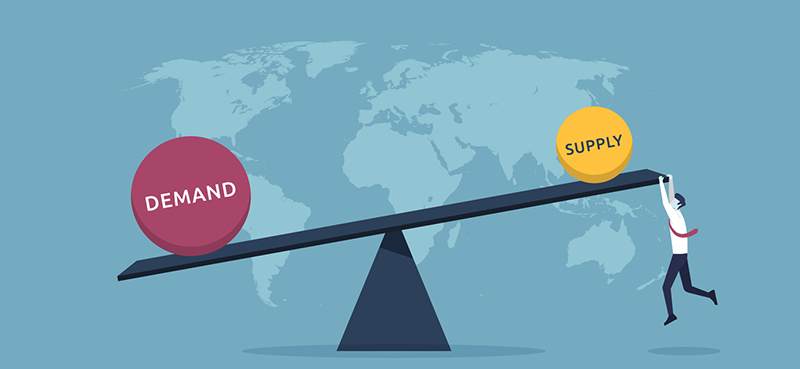
Demand is surging faster than new supply can be brought online.
For example, artificial intelligence is driving an unprecedented buildout of computing infrastructure. Electrification is placing greater pressure on power grids and commodity supplies. And years of underinvestment in traditional energy have increased the need for new oil discoveries.
But the physical economy cannot expand overnight.
Power plants take years to build. Grid connections are increasingly difficult to secure. New mines face long development timelines. And major oil producers are struggling to replace the reserves they consume.
Those constraints are beginning to reshape entire industries—and change what certain assets are worth.
Here are three of the biggest bottlenecks we’re watching—and how we’re positioning around them.
1. AI & power infrastructure
AI’s growing appetite for electricity is beginning to reshape the power and infrastructure markets.
Every new data center needs transformers, substations, cooling systems, grid connections, and dependable electricity around the clock.
In many regions, those supporting systems have become the limiting factor.
The electrical grid was not built for the speed or scale of the current AI expansion. New generation and transmission projects can take years to permit and construct, while utilities face growing backlogs from developers seeking new connections.
That is increasing the value of infrastructure that already has access to power.
Bitcoin miners spent years securing many of the same assets AI developers now urgently need: large power allocations, grid connections, land, cooling systems, and facilities designed to support energy-intensive computing.
Those assets can potentially generate far more value when used for high-performance computing.
A megawatt serving a Bitcoin-mining operation is generally valued far below one supporting an AI data center. The electricity may be the same, but the customer, revenue potential, and valuation attached to it can change dramatically.
DigiPower X (DGXX) is a strong example of that shift. The company already controls power generation and computing infrastructure historically associated with Bitcoin mining.
As it redirects that capacity toward high-performance computing and develops its AI data-center platform, it’s evolving from a crypto-mining company into a potentially much more valuable AI infrastructure business.
VivoPower International (VIVO) approaches the same bottleneck from another direction. Rather than simply repurposing existing mining infrastructure, the company is assembling the full foundation required for AI data centers: land, secured power, supporting infrastructure, and prospective customers.
It gives us direct exposure to one of the hardest parts of the AI buildout—finding viable sites with dependable electricity.
2. Energy & oil reserves
The global economy’s energy needs extend far beyond data centers.
Oil remains essential to transportation, manufacturing, petrochemicals, and countless industrial processes. Yet major producers have spent years consuming reserves faster than they have replaced them.
Existing fields naturally decline over time. That means oil companies must continuously discover and develop new resources simply to maintain production.
At the same time, the economics of offshore drilling have improved considerably.
Deepwater projects were once viewed as expensive, technically difficult investments that required extremely high oil prices to produce attractive returns.
But advances in drilling technology, project design, and operating efficiency have since brought development costs down substantially.
In 2016, deepwater projects often carried breakeven prices between $70 and $100 per barrel. Today, it’s about $40–$50.
That combination—depleting reserves and better drilling economics—is drawing renewed attention toward offshore regions capable of holding discoveries large enough to meaningfully move the needle.
West Africa is one of those regions.
The continent holds substantial petroleum reserves, and major energy companies are committing capital to offshore acreage as they search for the next generation of supply.
BluEnergies (BLUGF) gives us early exposure to that renewed exploration cycle. The company secured a large position offshore Liberia before interest in the region accelerated, and now TotalEnergies is leading the exploration program.
BLUGF remains a high-risk exploration-stage investment. There is no production or proven commercial discovery today.
But that’s also where the potential asymmetry comes from.
As major energy companies search for large new resources, early control of prospective offshore acreage can become increasingly valuable long before the first barrel is produced.
3. Technology & critical resources
The digital economy still depends on physical materials.
Data centers, power plants, transmission lines, cooling systems, electric vehicles, renewable projects, and industrial equipment all require enormous quantities of metals and other resources.
Copper is particularly important because of its ability to conduct electricity efficiently.
It is used throughout the power grid, data centers, electrical equipment, vehicles, cooling systems, and nearly every major electrification project.
As AI increases electricity consumption and governments invest in grid expansion, the demand for copper rises with it.
The problem: Discovering and developing a copper mine can take years. Companies must identify an economic deposit, complete extensive drilling and technical studies, secure permits, raise capital, build infrastructure, and eventually bring the project into production.
Simply put, the industry faces significant obstacles to expanding supply.
Coppernico Metals (CPPMF) gives us early-stage exposure to that trend. It owns a massive, underexplored project in a proven copper belt. If demand continues rising while new supply remains difficult to build, high-quality undeveloped copper assets could become increasingly strategic.
The bottom line: Invest on the scarce side of the market
When demand rises faster than supply, the assets that are hardest to recreate become more valuable.
That includes operational power infrastructure, secured grid capacity, prospective offshore acreage, and undeveloped mineral resources.
It also explains why many of today’s most compelling opportunities sit outside the companies receiving the biggest headlines. The growth may begin with AI, energy demand, or electrification—but the pressure eventually moves downstream toward the physical assets needed to support it.
That is where some of the market’s most overlooked opportunities are beginning to take shape.
Editor’s note:
This shifting market leadership is one of the main reasons we created Curzio Alpha.
Rather than separating our research into several narrowly defined sectors, Alpha brings our highest-conviction ideas together in one master portfolio.
That gives members exposure across AI, energy, infrastructure, commodities, biotechnology, crypto, and other major trends—without needing to assemble the pieces themselves.
Learn more about how Curzio Alpha can help you navigate the entire market.
MARKETING DISCLOSURES: Curzio Research provides paid marketing services for some companies. Full disclosures: BluEnergies Coppernico Metals