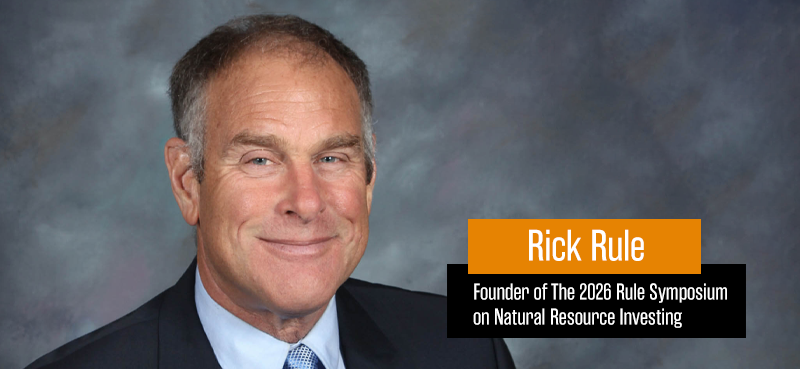
Rick Rule has forgotten more about resource investing than most analysts ever learn.
For decades, he’s been building, buying, and selling resource companies through every cycle imaginable. When he talks metals, investors should listen.
So when Frank got him on Wall Street Unplugged earlier this week, he made sure to go deep.
They covered the whole gamut: gold, silver, uranium, oil, and copper.
Here are the themes that stood out most.
Gold: The pullback doesn’t change the story
Gold is sitting around $4,300 an ounce right now—down sharply from its all-time high of $5,589 hit back on January 28. That’s a meaningful correction on the surface.
But Rick’s framing matters here: A pullback inside a bull market is not the same as a bull market ending.
And the structural reasons gold was moving higher haven’t gone away.
U.S. annual deficits are projected to approach or exceed $2.5 trillion, and bond market investors are demanding higher yields to hold long-duration government debt. In other words, they want a higher return to offset the risk of being repaid in weaker dollars over time.
That keeps the dollar’s purchasing power under pressure, and gold is one of the clearest beneficiaries when that happens.
Where it gets especially interesting is on the mining side.
Gold majors are sitting on a reserve replacement crisis: They’re depleting their ore bodies faster than they’re finding new ones.
With metal prices still elevated, acquiring junior miners with proven assets is often cheaper than building new mines from scratch.
That’s why Rick believes this M&A cycle is one of the most compelling setups in the sector right now.
Silver: Miners over metal
Silver has climbed toward $71 an ounce—a level that would have seemed extraordinary just a few years ago. But Rick prefers silver miners over physical silver for the speculative side of a portfolio.
Miners tend to amplify the metal’s underlying move in both directions—more upside when prices climb, more downside when they fall.
That’s because of leverage.
Miners’ costs are largely fixed. So when silver prices rise, miners’ profit margins expand faster than the metal itself.
A miner pulling silver out of the ground at a production cost of $20 per ounce makes dramatically more money when silver goes from $30 to $70 than the straight price move implies.
Rick has actually been rotating out of physical silver and into silver mining equities to capture that leverage.
Uranium: Long runway, patient money
Uranium spot prices have been sitting around $85 per pound since early April after a volatile run earlier in the year.
The spot market—where buyers and sellers trade for near-term delivery—has been quiet, with utilities relying on long-term contracts rather than active spot buying.
But a quiet spot market can be misleading.
The structural supply deficit is real. The world simply isn’t producing enough uranium to meet the demand from the current nuclear fleet, let alone the new reactors being built across Asia and Europe.
Rick’s view is that this is a decade-long story, not a quarter-long trade. Patience is the edge.
For investors, the most direct exposure comes through miners like Cameco (CCJ), the largest publicly traded uranium company in North America, or through funds like the Sprott Physical Uranium Trust (U.U).
Copper and oil: The industrial backbone
Copper is the metal that moves when economies grow. It’s in every wire, motor, and EV battery. The electrification buildout, from data centers to electric vehicles to grid upgrades, keeps the long-term demand story intact.
On oil, the conversation touched on how geopolitical shifts—particularly the recent U.S.-Iran peace agreement—are reshaping assumptions about energy supply in real time.
Oil prices pulled back to a two-month low following the announcement. That kind of headline-driven volatility is exactly the environment in which patient, valuation-focused investors find setups with large potential upside relative to downside risk.
The bigger picture
What ties all of this together is a simple idea Rick keeps coming back to: The resource sector is cyclical, and the best time to buy is when nobody wants to.
Right now, gold and silver are pulling back from highs, uranium is consolidating, and most retail investors are focused on AI and tech. That’s often exactly when the real opportunities appear.
Prices reflect the pessimism, not the underlying supply-and-demand math.
You can watch the full episode here. If resources are any part of your portfolio, it’s worth an hour of your time.