
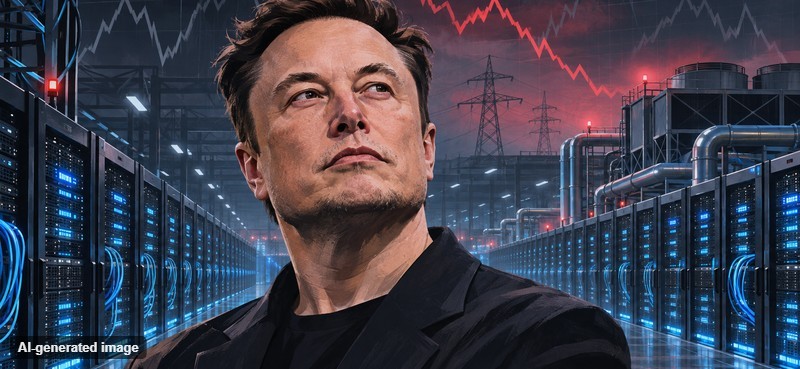
Elon Musk just admitted that one of his fastest-growing AI products costs more to operate than it can sustainably generate in revenue.
On November 1, a paying Grok Bot user asked Musk on X whether the company could reset their weekly usage allowance early. Musk responded that the cost of serving Grok Bot was “unsustainably high relative to revenue.”
Simply put, Grok Bot has a problem: Some customers can consume more computing power than their subscriptions pay for.
And the issue could grow even bigger as AI agents become more popular.
Yet the world’s largest technology companies are preparing to spend unprecedented amounts of money building AI infrastructure. In fact, S&P Global Ratings projects that combined hyperscaler capital spending will exceed $1.3 trillion in 2027.
So why are these companies spending so aggressively when the economics of AI remain uncertain?
The answer reveals an important distinction between the companies developing AI applications… and the companies providing the infrastructure to run them.
And it could help investors identify which AI stocks are best positioned to profit from the boom.
Grok Bot exposes AI’s growing cost problem
Most of us are familiar with AI chatbots like ChatGPT. You ask a question, the AI processes your request, and it generates an answer.
AI agents take things much further. Instead of simply answering a question, an agent can complete an entire assignment for you.
For example, you could ask an AI agent to research vacation destinations, compare flights and hotels, and build a detailed itinerary. To accomplish that task, it might need to search dozens of websites, analyze information, make decisions, and repeatedly call on AI models to complete each step.
Because AI agents can perform dozens or even hundreds of individual steps, a single assignment can require far more computing power than a typical chatbot response. And that computing power costs money.
Which brings us back to Grok Bot.
The service had already reached approximately 800,000 paid weekly users in early October. But under a flat-rate subscription model, customers can consume vastly different amounts of computing power while paying the same monthly fee.
A customer who completes a few simple assignments might be relatively inexpensive to serve. But someone running complicated AI tasks all day could cost substantially more.
That’s a major challenge for AI companies. They can raise prices, limit usage, charge customers based on how much computing power they consume, or find ways to make their models more efficient. (And AI is getting more efficient, which could reduce the cost of individual tasks over time.)
But cheaper AI could also encourage customers to use it much more frequently, potentially increasing overall demand for computing power.
The bottom line is that growing AI usage doesn’t automatically translate into growing profits.
Why Big Tech keeps spending anyway
Despite these profitability concerns, demand for AI computing capacity keeps growing.
And we’re seeing that demand translate into real revenue for the companies providing it.
Microsoft (MSFT) reported that Azure revenue jumped 48% year over year in the latest quarter, while revenue from its AI Foundry platform more than tripled. Even with that growth, Microsoft says customer demand continues to exceed its available computing capacity.
Amazon (AMZN) is seeing a similar trend. Its AWS cloud business grew 39.3% year over year—its fastest pace in nearly five years. And according to CEO Andy Jassy, customers are consuming new computing capacity almost as quickly as Amazon can install it.
Meanwhile, Alphabet (GOOG) says Google Cloud has already generated tens of billions of dollars in AI revenue this year. Demand is so strong that the company has started renting additional computing capacity from outside providers.
Simply, customers are already paying for AI computing services, revenue is growing rapidly, and some of the largest providers still don’t have enough capacity to meet demand.
These results give Big Tech a compelling reason to keep expanding—even while the economics of individual AI applications remain uncertain.
Of course, the enormous spending still creates financial risks. S&P Global Ratings expects six major hyperscalers—including Amazon, Microsoft, Alphabet, and Meta—to generate negative free operating cash flow in both 2026 and 2027.
That means their projected operating cash generation won’t be enough to cover their heavy capital investments. It doesn’t mean their existing businesses are necessarily unprofitable… But it shows just how much money they’re committing to AI’s future.
Ultimately, those investments need to generate attractive returns. That’s the key distinction investors need to understand: Strong demand for AI computing doesn’t guarantee strong profits for every company providing it.
The AI business is already generating billions—even as Grok struggles
Musk’s own company illustrates how differently the economics can look across the AI industry.
Earlier this year, SpaceX acquired xAI. And in the third quarter, its Super Intelligence division generated $7.56 billion in revenue, up from $813 million a year earlier. The division also reported $431 million in operating profit, compared with a $1.7 billion operating loss a year earlier.
That division includes AI software as well as cloud and infrastructure services.
Simply put, while Grok Bot is struggling with the cost of serving some customers, SpaceX’s broader AI business is already generating billions in revenue and reporting an operating profit.
It’s a reminder that the economics of individual AI applications can look very different from those of the businesses supplying the computing power and services behind them.
What this means for investors
Of course, generating revenue from AI infrastructure doesn’t automatically make a company a good investment. Building and operating that infrastructure requires enormous upfront spending. Companies have to recover those costs… and earn enough additional profits to justify the investment.
That’s why, as AI infrastructure spending accelerates, financial strength is becoming increasingly important. Companies need billions of dollars to buy chips, build data centers, secure electricity, and build the systems needed to deliver computing power to customers. And those investments can take years to pay off.
That gives established technology giants an important advantage. Companies like Amazon, Microsoft, and Alphabet have enormous existing businesses that generate cash to help fund their AI investments.
Smaller companies face a different challenge. Many specialized AI cloud providers, known as “neoclouds,” depend heavily on debt, outside investors, or customer financing to fund their expansion.
And if a project gets delayed, construction costs rise, or a major customer runs into financial trouble, a heavily indebted company could find itself struggling to meet its obligations. Some may be forced to raise additional capital, dilute shareholders, renegotiate financing agreements, or sell assets.
Meanwhile, financially stronger competitors could have opportunities to acquire infrastructure or negotiate more favorable terms.
That doesn’t mean every smaller AI infrastructure company is destined to fail. Some have valuable assets, strong customers, and financing arrangements that could allow them to thrive. But it does mean investors need to be increasingly selective.
As we evaluate AI infrastructure opportunities, we’re focusing on three critical factors:
Financial strength: Does the company have enough cash and access to financing to complete its projects without taking on excessive debt or repeatedly diluting shareholders?
Customer quality: Does it have reliable customers and contracts that provide visibility into future revenue?
Return on investment: After accounting for construction costs, financing expenses, and the need to upgrade hardware, can the company generate attractive profits from its infrastructure?
These factors could separate long-term winners from companies that struggle to survive the spending boom.
The bottom line
Musk’s admission about Grok Bot highlights a major challenge facing the AI industry: Rapid growth doesn’t necessarily translate into profitability.
That creates opportunities for investors—but also significant risks.
As the industry matures, we expect the biggest winners to be companies with the financial strength, reliable customers, and profitable business models to justify their enormous investments.
And those are exactly the opportunities we’re looking for.
Want to learn more about how Frank is trading the AI infrastructure boom? Stay tuned to Wall Street Unplugged.
Curzio Research publishes market commentary for informational and educational purposes. The opinions expressed and market conditions when the content is published may change. It is not personalized investment advice or an offer to buy or sell securities. Investing involves risk, including possible loss of principal. Do your own research and consult a qualified investment professional before making investment decisions.