
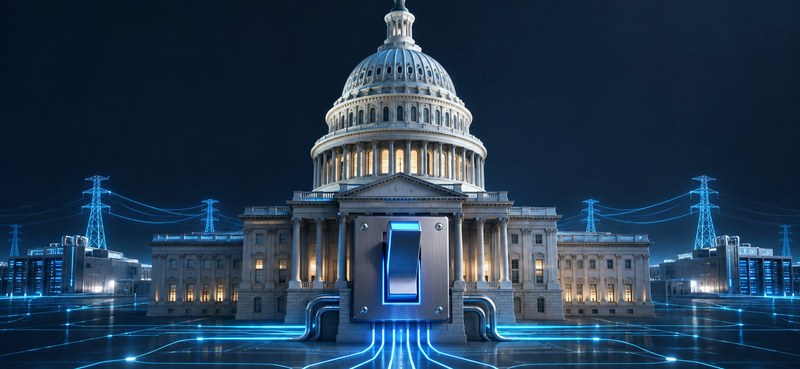
America’s AI boom has a major problem: The country can’t build enough power infrastructure fast enough to keep up.
Now, Washington may finally be doing something about it.
On Monday, the Senate voted 73–25 to advance a bipartisan bill designed to speed up approvals for energy and infrastructure projects.
Before getting too excited, investors should understand that the bill is far from a done deal. Monday’s vote was procedural; it allowed the Senate to move forward with debate, but the legislation still needs final approval. And if the Senate ultimately passes the bill, the House would still need to approve it.
But if it becomes law, the legislation could help unlock major investments in power plants, transmission lines, pipelines, and mining projects that have been stalled by regulatory uncertainty.
That could be great news for America’s AI ambitions… But investors shouldn’t overlook another side of this story.
The legislation would also change how data centers pay for the electricity infrastructure they need. Under the proposed rules, data centers would shoulder an estimated $55 billion in transmission costs over the next decade.
And that could have major implications for which companies benefit most from America’s next wave of infrastructure spending.
Here’s why we believe some of the biggest opportunities could be in the companies building the infrastructure… and what investors should watch as the legislation moves forward.
Washington just took a major step toward unlocking America’s power supply
The Bipartisan American Affordability and Jobs Act has a straightforward goal: to make it easier to get major energy and infrastructure projects approved and built.
Today, many large projects must undergo lengthy federal environmental reviews under the National Environmental Policy Act (NEPA). Developers can also face additional permitting requirements, coordination among government agencies, and legal challenges that create years of uncertainty.
And that uncertainty can be expensive.
Consider a company planning to build a new power plant. Before it can generate a dollar of revenue, it may need to spend millions on engineering, environmental studies, legal work, and other preparations.
If the approval process drags on for years, financing becomes more difficult. Construction costs can rise. And investors have to account for the possibility that the project never gets built.
The Senate bill aims to address those problems by improving coordination among federal agencies, strengthening permitting timelines, and limiting certain legal delays.
It would also expand federal authority to approve qualifying interstate transmission projects—an important step for moving electricity through the country’s grid.
The improved process could make a meaningful difference for developers trying to finance major projects. And it’s especially important right now, as AI companies race to secure enough electricity to support their growth.
But faster approvals are only half the story.
AI companies could face a $55 billion catch
One of the bill’s most consequential parts addresses who pays for America’s expanding power grid.
When a major data center connects to the grid, the utility serving it may have to build new power lines, substations, or other infrastructure to accommodate the additional electricity demand.
Under existing pricing arrangements, some of those costs can be spread across other electricity customers. That means households and businesses could end up paying part of the bill for infrastructure needed by the world’s largest technology companies.
The Senate legislation seeks to change that. Under the proposed rules, data centers would pay both their share of existing transmission costs and the additional costs they create.
The bill would also establish protections intended to prevent the costs of new data centers from being passed on to other customers. And it would require financial safeguards to help protect utilities and ratepayers if a data center shuts down before the infrastructure built to serve it has been paid for.
According to Senator Martin Heinrich and the bill’s supporters, these changes could shift an estimated $55 billion in grid-related costs onto data centers over the next decade—roughly $35 billion more than under current policy.
That raises an important question: What happens to the economics of AI development when companies building data centers have to shoulder more infrastructure costs themselves?
For technology giants like Amazon (AMZN), Microsoft (MSFT), and Alphabet (GOOGL), the tradeoff could still be worthwhile. These companies have enormous financial resources. And for them, gaining access to reliable electricity sooner could be worth paying more upfront.
But smaller AI infrastructure developers may face a different equation. A company with limited capital could struggle to absorb additional grid-connection costs, especially if it’s still trying to secure customers or financing. That could make it harder for speculative projects to get off the ground.
In other words, the legislation could actually strengthen the competitive advantages of well-funded companies… while raising the financial hurdles for some of their smaller rivals.
As the AI build-out accelerates, access to capital and reliable electricity could become even more important competitive advantages.
And that brings us to where we see some of the most interesting investment opportunities.
The biggest winners may be the companies building the infrastructure
When investors think about the AI boom, they naturally gravitate toward the companies developing chips, building data centers, and selling AI services.
But consider what has to happen before any of that technology can operate. Someone has to build the power plants, install the transmission lines and substations, construct the pipelines that supply fuel to new natural gas facilities, and provide the equipment and skilled labor needed to bring these projects online.
That’s why we’re particularly interested in the businesses that make this expansion possible.
Take Quanta Services (PWR), which provides specialized contracting services for electric power infrastructure. If permitting reform allows more projects to move forward, infrastructure contracting companies like Quanta could see additional demand for their services.
Pipeline operators like Williams Companies (WMB) and Kinder Morgan (KMI) could also benefit if faster approvals help move additional natural gas infrastructure projects forward.
Companies developing power plants, energy storage systems, and domestic mining projects could likewise benefit from reduced regulatory uncertainty.
Of course, removing regulatory obstacles doesn’t guarantee a profitable investment. Projects still need sufficient demand, reasonable construction costs, and financing. But it could change how investors assess the risk—and value—of certain infrastructure assets.
The bottom line
The Senate’s permitting deal could mark an important turning point for America’s energy infrastructure.
For years, regulatory uncertainty has made it hard, slow, and expensive to develop major projects. Now, with AI driving enormous new electricity demand, Washington has a powerful incentive to clear some of those obstacles.
But investors need to look beyond the obvious beneficiaries. The same legislation that makes it easier to build energy infrastructure could also force AI developers to pay more of the costs.
That could favor companies with strong balance sheets, reliable access to electricity, and the resources to bring major projects online.
Meanwhile, the businesses that construct the grid, supply equipment, and develop new energy projects could see a growing pipeline of opportunities.
We’ll be watching whether the bill makes it through Congress… and, more importantly, whether faster approvals eventually translate into signed contracts, funded projects, and new construction. Stay up to date by tuning in to Wall Street Unplugged.
Curzio Research publishes market commentary for informational and educational purposes. The opinions expressed and market conditions when the content is published may change. It is not personalized investment advice or an offer to buy or sell securities. Investing involves risk, including possible loss of principal. Do your own research and consult a qualified investment professional before making investment decisions.