

The market is doing something we haven't seen in years.
According to a November 19 report from LPL Financial, the S&P 500 technology sector trades at just 16.9 times (16.9x) forward earnings, compared with 17.8x for the overall S&P 500.
It's the first time tech has traded at a discount to the market since 2019.
The strange part: Tech earnings are expected to grow roughly 4x faster than the rest of the market next year.
Yet, investors are paying more for slower-growing companies in other sectors.
This disconnect is creating an opportunity to buy some of the market's best businesses at unusually attractive valuations.
But not every beaten-down tech stock deserves to recover.
Let’s look at where we see the opportunity… and what investors need to watch. But first, a quick breakdown of the numbers…
Tech stocks are getting cheaper as profits grow
A stock's price-to-earnings (P/E) ratio tells you how much investors are paying for each dollar of a company's annual profit. A forward P/E uses analysts' expected earnings over the next 12 months.
A falling P/E can mean a stock is getting cheaper because its price has dropped, its expected earnings have risen, or both.
Both factors are at play across much of the tech sector.
After soaring above 30x forward earnings in 2025, tech valuations have fallen dramatically as investors sell AI and semiconductor stocks.
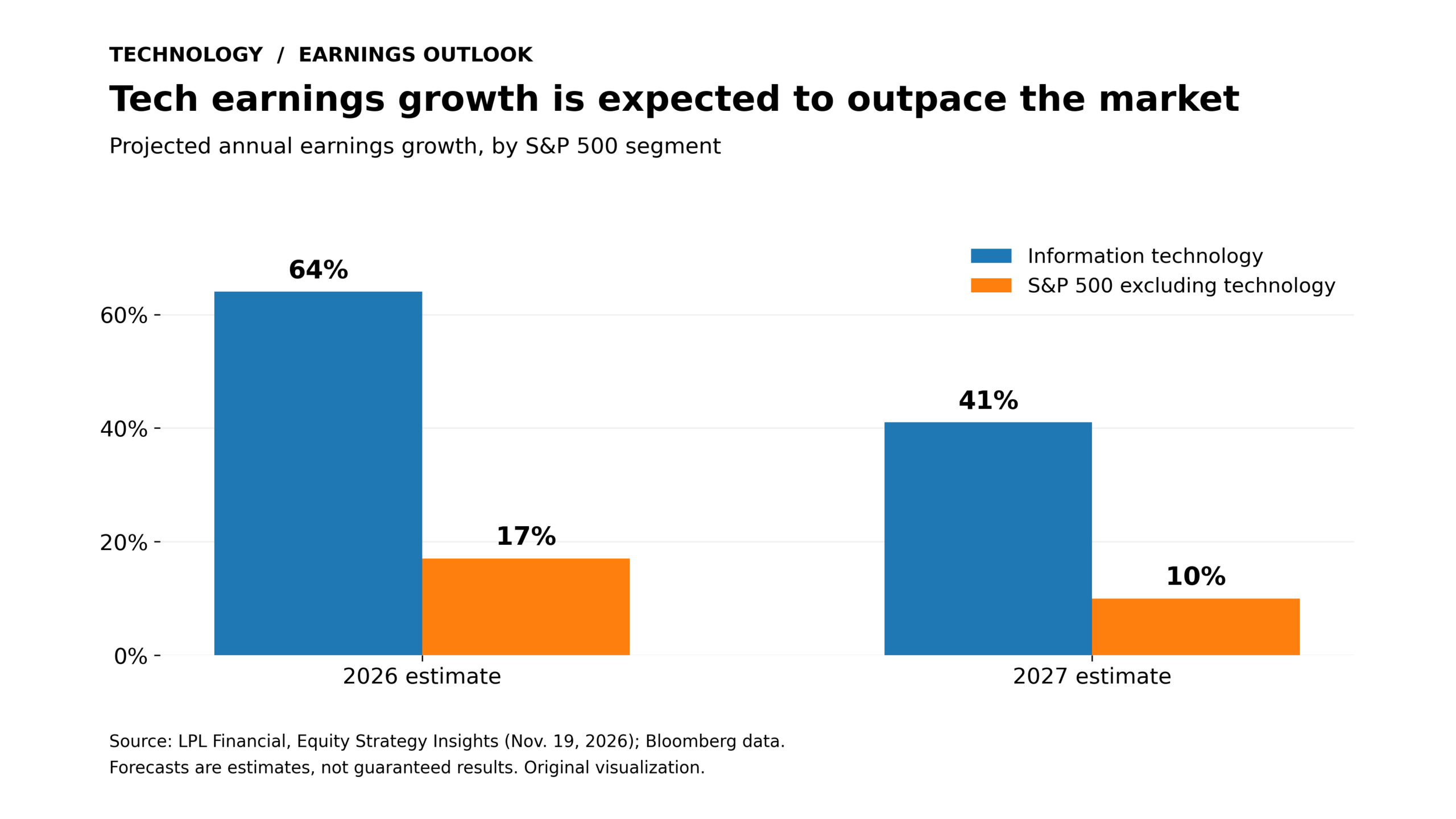
But the sector's underlying earnings outlook remains remarkably strong. According to LPL Financial's research, tech earnings are projected to grow 64% in 2026, compared with 17% for the rest of the S&P 500.
And that outperformance is expected to continue: In 2027, tech earnings are projected to grow 41%, versus just 10% for the rest of the market.
Even more impressive, tech has generated operating profit margins more than twice those of the rest of the S&P 500 every year since 2016.
In other words, investors are paying a below-market valuation for a sector expected to deliver substantially faster earnings growth and stronger profit margins. Historically, investors have been willing to pay a premium for those advantages. Today, they're getting them at a discount.
Investors are paying a premium for safety instead
So why are tech stocks getting cheaper despite such strong fundamentals? A big part of the answer is where investors are putting their money.
As concerns about AI spending and future profitability have mounted, investors have been shifting out of technology and into defensive stocks—i.e., companies that sell everyday necessities and tend to hold up better during economic uncertainty.
But that rush toward safety has created its own valuation extremes.
According to Duality Research, cited by Yahoo Finance, the consumer staples sector recently traded at 24.2x forward earnings, its highest valuation since 1999. At the same time, tech traded at just 17.2x earnings.
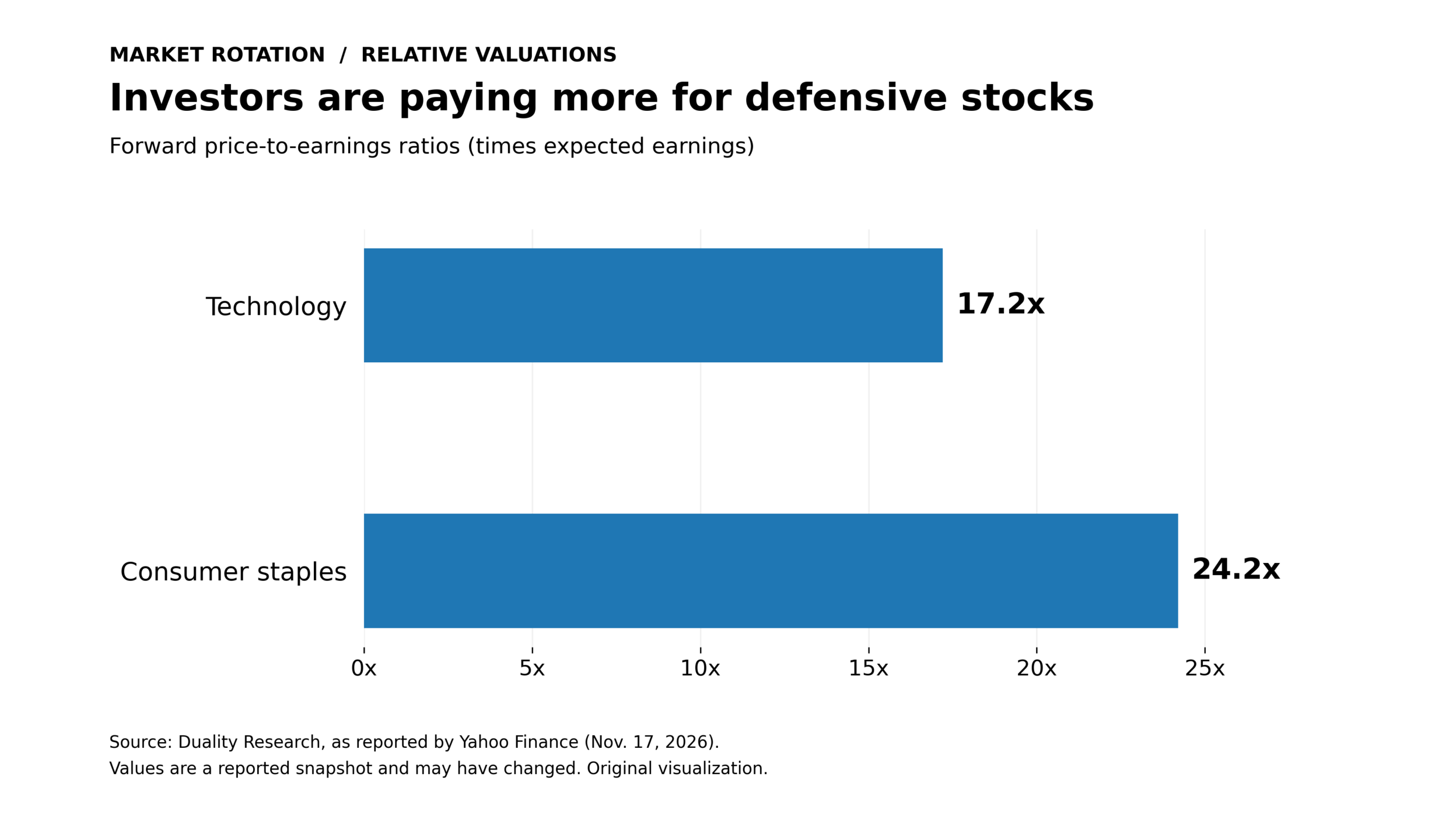
That means investors were paying roughly 41% more per dollar of expected profits for consumer staples than for technology companies.
The gap shows just how aggressively investors have abandoned growth in favor of perceived safety.
And that’s creating opportunities in the companies they're selling.
Where investors should look for opportunities
The best opportunities will come from tech companies whose stock prices have fallen much further than their underlying businesses have deteriorated.
Take Nvidia (NVDA).
The AI chip giant has been absolutely hammered. Since hitting an all-time closing high of $239.24 on October 6, shares have fallen nearly 40%, closing at $145.98 on November 19. The selloff largely stems from controversy surrounding former CEO Jensen Huang and concerns about the sustainability of AI spending.
But the company's business tells a very different story. On November 17, Nvidia reported quarterly revenue of $115.8 billion, up 103% year over year. Net income climbed 105%, and the company forecast another record quarter ahead.
Yet the stock continued to slide despite those blowout results.
To be clear, Nvidia faces legitimate risks, including uncertain leadership and potential restrictions on chip exports. But those concerns have also driven Nvidia's valuation sharply lower, even as its earnings continue to surge.
And that's exactly the kind of disconnect we're looking for: Companies whose stock prices have fallen dramatically even as their underlying businesses continue to deliver exceptional results.
The biggest risk to this opportunity
Of course, investors have good reason for their growing skepticism around tech: Much of the sector's attractive valuation depends on earnings growth that hasn't happened yet. And while the forecasts are positive, they’re not guarantees.
AI companies are spending enormous sums on data centers, chips, and other infrastructure. If that investment doesn't generate the expected returns, earnings estimates could come down. That would make today's seemingly cheap valuations less attractive.
Higher interest rates add another challenge. The Federal Reserve raised rates in September, and Governor Christopher Waller recently warned that the Fed may need to raise rates by half a percentage point in December to combat persistent inflation.
Higher rates make borrowing more expensive. They also reduce the present value investors assign to future profits, putting additional pressure on growth stock valuations.
That means even fundamentally strong tech companies could face more volatility before the market turns around.
The bottom line
Tech stocks are trading at a discount to the broader market even as their earnings are expected to grow dramatically faster. Meanwhile, investors are paying historically high valuations for defensive stocks.
That disconnect has created some compelling opportunities. The key is being selective.
The companies that ultimately reward investors will be those that can sustain their growth, generate real cash flow, and justify their valuations.
Want to know which tech stocks we're buying during this selloff?
Just today in Curzio Alpha, Frank released a “BUY” alert for 4 of his favorite beaten-down AI stocks.
Get the names as soon as you join Curzio Alpha.
Curzio Research publishes market commentary for informational and educational purposes. The opinions expressed and market conditions when the content is published may change. It is not personalized investment advice or an offer to buy or sell securities. Investing involves risk, including possible loss of principal. Do your own research and consult a qualified investment professional before making investment decisions.