
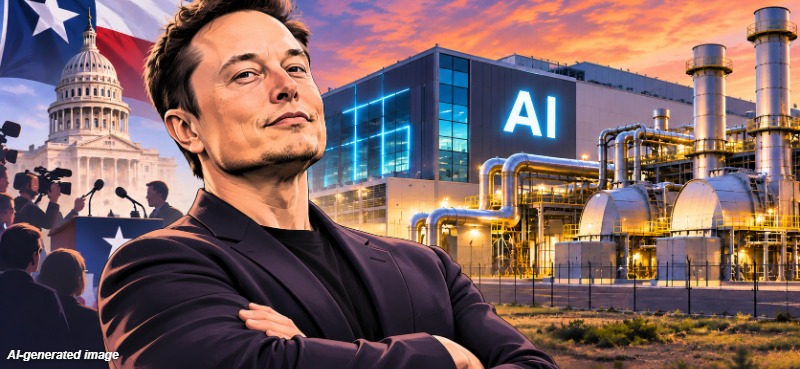
Everyone is talking about how Elon Musk just beat Texas politicians to the punch.
And for good reason: SpaceX just secured a key environmental permit for its proposed $24 billion AI supercomputing facility and power plant in Texas… just weeks before a new governor takes office who's threatening to freeze data center development.
It's a big victory for Musk, and the political drama is grabbing plenty of attention.
But investors are missing the much bigger story. And it tells us something important about where the AI boom is heading… and which companies stand to profit.
We’ll explain in a minute, but first, let’s recap the headlines.
How SpaceX beat the political clock
Texas has become a battleground over the explosive growth of AI data centers. Residents and lawmakers are increasingly concerned about their impact on electricity supplies, water resources, and local communities.
In September, Governor Greg Abbott temporarily paused data center permitting while state regulators examined those concerns.
Then, earlier this month, Democrat Gina Hinojosa defeated Abbott in the governor's race. Hinojosa has called for a moratorium on new data center approvals until lawmakers establish stronger protections for residents.
But before she could take office, Abbott's administration completed the initial regulatory review, allowing the state to resume issuing permits. SpaceX was among the first to get approval.
The permit doesn't make the project immune to future political challenges. But it clears an important regulatory hurdle before Hinojosa takes office in January.
That's the political story everyone else is watching… But here’s what we’re paying attention to.
AI companies are building their own power plants
SpaceX's proposed facility includes a power plant with 35 natural-gas turbines capable of generating roughly 750 megawatts of electricity. That's enough electricity to power hundreds of thousands of homes.
Why go to such extraordinary lengths?
Simple: because electricity has become one of the biggest obstacles to AI growth.
Companies are pouring billions into data centers packed with expensive chips and computing equipment. But connecting those facilities to the electrical grid can take years, especially in regions where demand is already stretching the existing infrastructure.
Consider that every month a completed data center sits idle waiting for electricity is another month that billions of dollars in equipment aren't generating revenue.
For some of the biggest AI companies, building their own power plants is becoming a more attractive alternative to waiting for utilities to catch up. As the AI buildout accelerates, developers are increasingly looking at natural-gas turbines and other on-site solutions to secure reliable electricity.
And that's creating an enormous opportunity for the companies supplying the equipment.
The companies getting paid to power the AI boom
Wall Street loves chasing the next big AI breakthrough. But while the tech giants fight over who will dominate artificial intelligence, the real winners are the pick-and-shovel stocks supplying the infrastructure they all need.
For instance, look at GE Vernova (GEV), one of the world's leading gas turbine manufacturers.
SpaceX's plans call for its initial 35 turbines to eventually be replaced by eight permanent GE Vernova 7E turbines, generating approximately 708 megawatts.
Better yet, GE Vernova is seeing a massive surge in orders. In its third-quarter earnings report, the company reported that its gas power equipment backlog and manufacturing slot reservations had reached 122 gigawatts. And its total company backlog climbed to $197 billion.
And here's another great part of GE Vernova's business: Selling a turbine is only the beginning. These machines require ongoing maintenance and servicing over decades of operation. As GE Vernova's installed base grows, so does its opportunity to earn recurring service revenue.
Another pick-and-shovel winner: Eaton (ETN). The company manufactures switchgear, power distribution systems, and other electrical infrastructure needed to move power safely and reliably to thousands of servers.
And here's the beauty of Eaton's position: Its equipment is needed whether a data center gets power from the grid or generates it on-site.
Business is booming. In its latest quarterly results, Eaton reported 19% organic sales growth. Orders in its Electrical Americas division surged 39% on a rolling 12-month basis, while its total electrical backlog climbed 46% year over year.
Of course, neither company is immune to a market selloff. Higher costs and regulatory delays could also slow future projects.
But these companies have something important in common: exposure to the massive AI growth trend… without having to predict which AI developer ultimately comes out on top.
The bottom line
Elon Musk may have won an important round in the Texas political fight. But there’s a much bigger takeaway for investors: AI developers are increasingly taking power generation into their own hands, creating new demand for turbines, electrical equipment, and supporting infrastructure.
And companies like GE Vernova and Eaton are already seeing that demand translate into billions in orders.
While everyone else is watching the fight over who gets to build the next AI data center, we’re watching the companies getting paid to power them.
Want to know which stocks Frank is buying to profit from the AI growth trend? Get every stock recommendation and trade alert we make when you join Curzio Alpha.
Curzio Research publishes market commentary for informational and educational purposes. The opinions expressed and market conditions when the content is published may change. It is not personalized investment advice or an offer to buy or sell securities. Investing involves risk, including possible loss of principal. Do your own research and consult a qualified investment professional before making investment decisions.