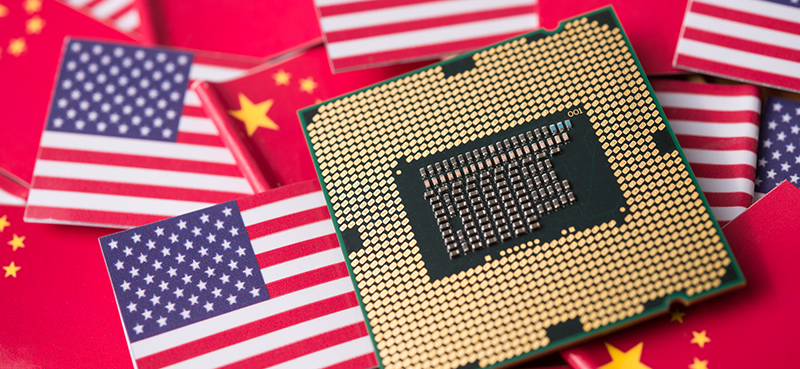
Last week, President Trump signed a deal that will allow Nvidia (NVDA) to sell its advanced H200 AI chips to China, with the U.S. government taking a 25% cut of the sales. The move reverses prior export restrictions.
The reaction was immediate.
Critics called it reckless… Supporters called it pragmatic… And the markets focused almost entirely on Nvidia.
But buried beneath the politics and the sound bites is a much more important reality for investors: This deal reshapes the global AI market… and the biggest winner isn’t the company grabbing all the headlines.
The headline everyone saw—but misunderstood
On the surface, Trump’s deal with Nvidia raised obvious concerns: Should the U.S. be selling strategic technology to a geopolitical rival? Does this open the door to deeper national security risks?
Those are valid questions—but they miss a crucial point.
For years, U.S. policy assumed that tighter restrictions would meaningfully limit China’s access to advanced semiconductors.
In practice, that strategy has proven flawed… as China’s black market for chips thrived. For instance, back in July, The Financial Times reported that over $1 billion worth of Nvidia chips had reached China’s black market.
Simply put, China is going to get these chips whether we like it or not.
The difference now is we’re not pretending otherwise. We can see what’s happening, keep an eye on it, and actually make money instead of sticking our heads in the sand.
That’s not surrender. That’s dealing with reality.
The global AI race changes the logic
There’s also a bigger issue at play: The global AI race.
If you believe AI will define economic leadership over the next several decades (and we do), then the goal isn’t simply blocking competitors; it’s ensuring that the world builds on your technology stack.
Supporters of this approach—including Crypto Czar David Sacks—believe winning the AI race isn’t just about blocking competitors; it’s about making sure the world builds on U.S. technology. If developers worldwide use American hardware, the U.S. maintains its influence. It’s that simple.
Trying to lock China out completely would likely backfire, pushing them faster toward their own AI ecosystem.
The $50 billion market no one is focusing on
Here’s where the investing story begins.
China’s GPU market is estimated at roughly $50 billion. Even assuming U.S. chipmakers capture only a modest share of that market, the revenue impact quickly becomes significant.
For instance, let’s say U.S. chipmakers collectively capture just 20% of that market. That’s $10 billion in annual sales.
Now here’s the key detail most investors are missing: Nvidia isn’t the only U.S. chipmaker allowed to sell into China. AMD (AMD) will also be permitted.
Technically, Intel (INTC) was also included in the deal, but this opportunity meaningfully impacts Nvidia and AMD, whose AI chips are actually competitive in the high-end market.
The Nvidia headlines hide a much bigger story
Nvidia dominates the conversation because it dominates the AI chip market. But dominance cuts both ways.
Nvidia is expected to generate roughly $200 billion in revenue this year, with a market cap of around $4.5 trillion. Even an additional $5 billion in sales only moves the needle by about 2.5%.
On the other hand, AMD’s annual revenue base is far smaller, and its market cap sits closer to $360 billion. If AMD captures even $5 billion of that China opportunity, that represents 15%+ incremental revenue growth.
So, while Nvidia needs the China deal to support expectations, AMD can use it to materially change its growth trajectory.
Margins, government cuts, and what really moves stocks
Yes, the 25% government cut will compress margins. There’s no way around that.
But remember, stocks don’t move on margins alone; they move on growth, scale, and expectations.
Nvidia already operates at an elite scale with elite margins. Its challenge isn’t demand; it’s scale. At a $4.5 trillion valuation, Nvidia needs massive incremental growth to meaningfully move the stock.
Meanwhile, AMD is still in expansion mode, fighting for a share of an enormous total addressable market. Incremental revenue has an outsized impact on its financial profile and long-term narrative.
We’ve seen this play out in other industries before.
In cloud computing, Amazon remained the leader, but Microsoft, Google, Oracle, and others all built massive businesses by taking slices of a gigantic pie.
AI infrastructure is shaping up the same way.
Why this deal could actually stabilize markets
There’s a macro factor at play, too…
Markets don’t like surprises—especially the kind that come from trade wars and tariff headlines. We saw that firsthand when tariffs escalated, and stocks immediately sold off.
This deal points to improved U.S.-China relations—which, in turn, support global growth, supply chains, and risk assets.
The bottom line
China will get advanced AI chips one way or another. That reality isn’t changing.
What is changing is who controls the process, who profits from it, and which companies see meaningful upside.
Nvidia benefits, no question. But AMD benefits far more.
For more deep market insights—and specific stock picks to play the latest trends—join Wall Street Unplugged Premium.