When regulators target Big Tech, investors usually brace for disruption.
That’s why the recent antitrust ruling against Alphabet (GOOG) caught so much attention. Last week, a federal judge confirmed what critics have argued for years—that Google holds a monopoly in search.
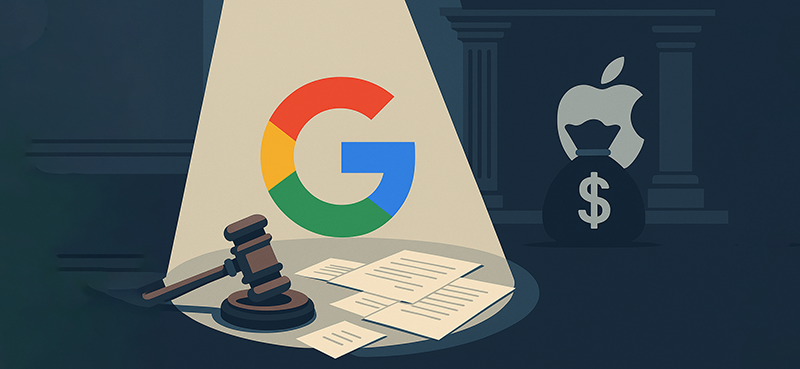
One of the key arguments against Google was its long-standing agreement with Apple (AAPL): Google pays billions annually to remain the default search engine on iPhones—a clear example of how it maintains dominance.
Many expected the case to spell trouble for both companies. However, instead of forcing a breakup or dismantling the partnership, the judge let the deal stand. In his decision, he noted that competition from artificial intelligence (AI) companies like ChatGPT and Perplexity was already creating pressure on Google’s moat.
In other words, despite being found to have a monopoly, Google avoided any serious penalties.
You might think that sets GOOG up for a leg higher… But the truth is that AAPL is the real winner of the ruling. Let’s look at why.
The $25 billion jackpot
At the center of this case is one of the most lucrative side deals in all of corporate America: Google pays Apple roughly $25 billion every year to be the iPhone’s default search engine. With 153 million iPhone users in the U.S. alone, Apple’s ecosystem provides Google with a constant flow of search traffic—and the ad dollars that come with it.
For Apple, it’s basically free money. No new iPhones need to be built. No new platforms need to be launched. This revenue drops almost entirely to the bottom line.
To put the scale in perspective: That $25 billion amounts to nearly 20% of Apple’s projected 2025 earnings—about $1.40 of its expected $7.30 EPS. Few companies in the entire S&P 500 generate that much profit annually. Apple gets it in a single, recurring check.
Google vs. Apple: The real winner
While Google celebrated the ruling, it’s hardly out of the woods.
AI search rivals like ChatGPT and Perplexity are gaining traction and threatening to siphon off users.
Moreover, regulatory risk isn’t going away. Just because this case ended without a breakup doesn’t mean the next one will.
It’s also worth noting that a lot more hinges on this deal for Google than for Apple. If regulators were to force the deal to end, Apple would lose a slice of its services revenue. But Google would risk losing its iron grip on mobile search.
The investor takeaway
The antitrust case that was supposed to hurt Google actually cemented Apple’s advantage.
Apple now enjoys a recurring, high-margin $25 billion revenue stream with virtually no cost attached.
And yet, investors haven’t fully priced in this tailwind. Apple’s stock has lagged the S&P 500 over the past year (up 7% vs. 17%).
Put simply, Wall Street is underestimating a major growth driver for the stock.
And for long-term investors, that makes Apple one of the best “big stock” bets on the market today.
Want more insight into what’s moving the market—and how to profit? Join Wall Street Unplugged Premium today.