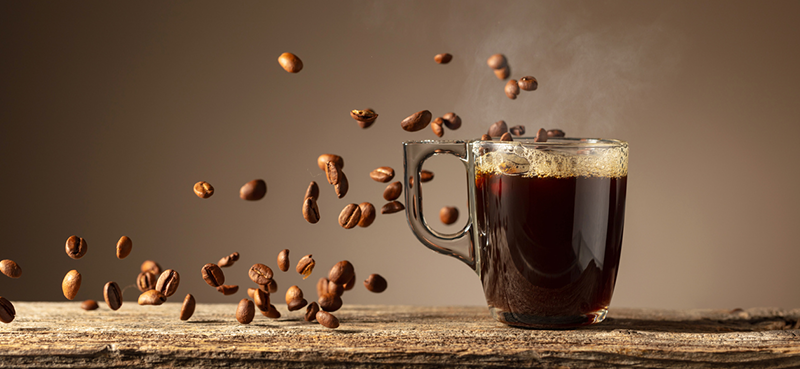
When you’re drinking that afternoon cup of decaf, you’re probably not thinking much about how it ended up in your cup…
You’re more likely wondering why decaf never seems to taste as good as the real thing… or wishing you didn’t have to choose between all or nothing when it comes to caffeine levels.
Both of these problems are related to the messy (and costly) decaffeinating process.
Here’s the simple version:
Most decaf today occurs before coffee is ever brewed.
Coffee beans are shipped to a decaf facility, where the caffeine is stripped out (often with chemicals or large water-based plants), and the beans are shipped again to be roasted/used.
That’s expensive, slow, and it can mess with taste.
It also has limited flexibility if you want something like half-caf or 25% caf.
For brands and manufacturers, that last point is becoming more of a problem as more consumers ask for custom caffeine—half-caf, 25% caf, even near-zero—options that are expensive and operationally messy to produce within today’s supply chain.
For investors, that kind of embedded inefficiency is usually where the opportunity lives…
Caffree’s wedge
Caffree is attacking decaf from a different angle.
Instead of removing caffeine at the bean level (before coffee is ever brewed), the company’s technology is designed to work after coffee is already liquid.
Caffree’s product is an enzyme powder that can be introduced into that liquid and specifically targets caffeine.
That might sound like a small operational tweak, but it’s much bigger than that.
It has the potential to remove an entire layer of logistics that exists solely because decaffeination happens too early in the chain.
If decaffeination can occur later—near the point of production—brands can stop routing product through specialized decaf facilities… simplify inventory, storage, and contamination controls… and create multiple caffeine levels from the same base batch.
In other words, Caffree isn’t asking the industry to behave differently.
It’s offering a way to meet changing consumer demand without paying the usual operational penalty.
Caffree’s early focus is a logical “wedge” market: large-volume cold coffee applications. But the longer-term roadmap points toward something bigger: in-the-moment caffeine control.
If a future version of the enzyme can work fast enough in hot coffee, the use cases expand:
- cafes and chains (custom caffeine at the point of sale)
- consumer products (single-serve “stick packs” that let you dial caffeine down yourself)
- broader caffeine categories beyond coffee
How Caffree solves the big taste problem
Most decaf innovations run into the same wall:
If the taste isn’t there, it doesn’t matter how elegant the chemistry is.
Caffree’s pitch is built around the idea that caffeine removal shouldn’t require stripping out aroma and flavor compounds.
The company has been running blind sensory tests with professional coffee graders (the people brands rely on for quality assurance).
According to CEO Eric Quick, the results have been consistent: graders have overwhelmingly been unable to tell the difference between enzyme-treated (decaffeinated) coffee and regular coffee. In fact, Quick said, most graders actually preferred the treated coffee over the untreated version.
If that continues to hold up as the company scales, it solves the biggest adoption hurdle in the category.
And it opens a second door that’s easy to miss:
Premium coffee brands have historically avoided decaf because existing methods degrade the product. A process that preserves flavor makes “caffeine-controlled premium coffee” viable. That expands the opportunity beyond the existing decaf market and into higher-end segments.
This setup is what private investors look for
Early-stage private investments are inherently risky. The question is whether the setup has the ingredients that give it a real chance to break out.
Caffree checks the boxes that matter most:
1. A real, expensive problem in a massive market
Caffree is targeting a $500 billion global category. Decaf alone is a $55–$60 billion market. The pain points (cost, taste, logistics) are well-known across the industry.
2. A wedge that doesn’t require changing human behavior
This isn’t trying to invent a new habit. People already consume these products. The company is improving the infrastructure behind them.
3. A model that can scale through enterprise relationships
If the product becomes embedded in manufacturing workflows, adoption can expand quickly through a small number of large customers.
4. Clear strategic optionality
If you’re disrupting part of the supply chain, you don’t need to win forever to create investor value. There are multiple ways private outcomes happen:
- Strategic acquisition by incumbents who need the tech
- Acquisition by ingredient/supply chain players that already sell to these customers
- Partnership/licensing structures that create predictable revenue streams
5. An all-star team
With technology developed inside the UC Davis ecosystem and leadership that has spent decades scaling food and coffee businesses, Caffree combines serious scientific depth with real-world operating experience.
The takeaway
Caffree is fundamentally betting on a simple idea: The current decaf system is too slow, expensive, and rigid to keep up with where the market is going.
If the company can maintain taste while reducing complexity and costs, it has a credible path to becoming a new standard in beverage production.
Editor’s note:
Frank says Caffree has more upside potential than anything he’s ever seen in the private markets.
And Curzio One members have a rare chance to get in.
Want to find out how you can join them?
Schedule a call with Frank to see if this opportunity is right for you.
But hurry! This deal is closing for good on March 31!