
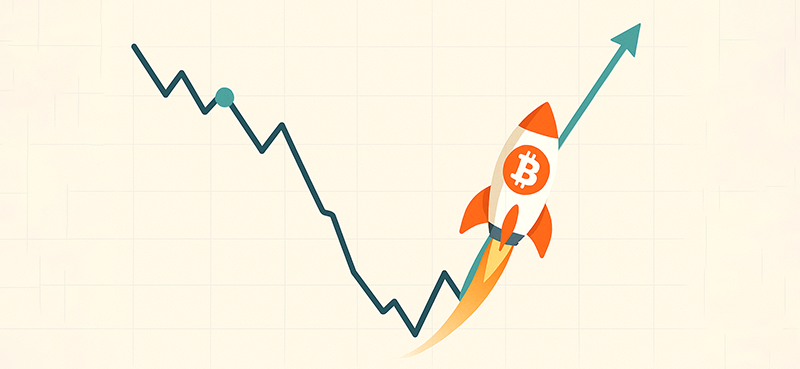
Bitcoin has just gone through one of its ugliest stretches in years.
From October highs around $125,000, it fell all the way to the low $80,000s. Altcoins got hit even harder—many down 40–80% in a matter of weeks. Sentiment is in the toilet.
But if you zoom out, this is exactly the kind of setup that tends to precede huge crypto rallies. Here’s why the recent carnage looks less like “the end of crypto” and more like the start of the next big move higher.
1. A selloff for the wrong reasons
The most important thing to understand about this downturn is that it wasn’t driven by fundamentals.
We didn’t suddenly discover that Bitcoin doesn’t work. The network didn’t break. Major protocols didn’t collapse.
The selloff is due to deleveraging.
In crypto, some platforms let traders use 20x, 30x, or even 50x leverage. That means a relatively small move down in Bitcoin can trigger margin calls and forced liquidations. And once those liquidations start, they feed on themselves: Traders sell their positions to meet margin calls, which pushes prices down further, triggering even more margin calls.
It’s the same dynamic we saw in the 2008 credit crisis. Subprime mortgages were bad on their own… But the real disaster came from Wall Street levering those mortgages 30-to-1. It only took a small drop in housing prices to blow up the entire system.
Now, many quality crypto names are down 40–80%, regardless of their actual utility or growth.
That’s painful… but it also creates an opportunity.
2. Institutional interest is picking up
For years, Vanguard was one of the most anti-crypto firms on Wall Street. But that changed in December 2025, when Vanguard began allowing its customers to buy and sell third-party crypto ETFs and mutual funds on its platform.
Vanguard has 55 million customers and oversees about $11 trillion in assets. Even a small allocation from a portion of its client base represents billions in potential inflows into Bitcoin-linked products.
Meanwhile, on January 6, 2026, Morgan Stanley announced it’s filing to offer ETFs for Bitcoin, Ethereum, and Solana.
And Goldman Sachs recently spent $2 billion acquiring Innovative Capital Management to expand its ETF footprint—a move widely viewed as a push to build and distribute more crypto-linked ETF products.
Goldman doesn’t spend billions building an ETF engine unless it plans to feed it with high-demand products… and right now, Bitcoin ETFs are among the fastest-growing categories in the world.
The timing of these moves is also significant: Institutions are lining up to buy right as the market has flushed out leverage and forced sellers.
3. States and sovereigns are buying
The U.S. government already controls a significant stash of Bitcoin via seizures… and there’s growing political interest in turning that into an official strategic reserve with new purchases, not just confiscated coins.
What’s more, Texas recently became the first state to begin building a state-level strategic Bitcoin reserve.
And several other countries, including Switzerland, Poland, Germany, Japan, and Russia, either hold Bitcoin already or are openly considering formal reserves.
Whether or not any specific proposal passes, it’s clear that more governments are treating Bitcoin as a legitimate long-term store of value.
4. The perfect macro backdrop for hard assets
Now layer the macro picture on top of everything above.
For one thing, the Federal Reserve has stopped quantitative tightening (it’s no longer shrinking its balance sheet).
With U.S. deficits barreling toward $40 trillion, the odds are high that we’ll see another round of quantitative easing (i.e., more money printing and debt monetization) at some point.
And when governments run massive deficits and central banks eventually return to money printing, investors tend to look for assets that can’t be debased.
Bitcoin is built for that environment: Its supply is fixed… its adoption keeps expanding… and its price is tightly linked to global liquidity.
Simply put, as liquidity rises and trust in fiat weakens, Bitcoin is poised to outperform.
5. Sentiment is washed out
Fundamentals explain why Bitcoin should do well over time… But sentiment tells you when to act.
Right now, sentiment is ugly. After dropping to “extreme fear,” sentiment is still in the “fear” range.
Historically, these types of readings have been excellent contrarian signals.
The last time the index spiked to “extreme fear” levels—in April 2025, when Bitcoin briefly dipped below $80,000—it rebounded more than 25% in a matter of weeks and eventually climbed toward its $120,000 peak later that year.
Why does this work?
By the time sentiment is that bad, most of the investors who are going to sell have already sold… Leveraged traders have already been liquidated… And the market is leaning heavily to one side.
You don’t tend to sit in “extreme fear” for long. The selling typically exhausts itself, and even a modest uptick in demand triggers a violent rebound.
We’ve already moved from “extreme fear” to “fear”… setting the stage for crypto’s turnaround.
What this means for investors
Bitcoin is still the dog that wags the tail.
When Bitcoin fell from $125k to the low $80k range, many altcoins dropped 40–80%. Some of that is justified (downturns tend to expose the junk). But a lot of it is indiscriminate selling tied to leverage.
That creates two big realities:
- The good stuff is on sale: High-quality projects with real utility, strong backers, and solid development teams are trading at massive discounts due to forced selling… not because they’re broken.
- Rebounds can be explosive: After this kind of washout, it’s not unusual to see good altcoins bounce 50–100% in weeks once Bitcoin regains its footing.
That’s the nature of this market. It’s brutal on the way down… and incredibly rewarding if you’re positioned correctly when the tide turns.
Here’s how to approach it in your portfolio:
Treat Bitcoin as part of your speculative bucket
Allocate a sensible slice of the capital you’re willing to put at risk for asymmetric upside. Don’t go blowing your emergency fund buying Bitcoin. If a 50% drawdown in your crypto holdings would keep you up at night, your position is too big.
Don’t use leverage
The fastest way to get wiped out in crypto is borrowing to try to juice your returns. Leverage is what just caused this latest bloodbath. You don’t want to be on the wrong side of the next one.
Focus on quality
When considering altcoins, look for assets that offerreal utility, clear use-cases, credible teams, and strong backing.
Accept that you won’t nail the bottom
No one can perfectly time the market. The goal isn’t calling the exact bottom; it’s getting in when the odds are heavily skewed in your favor.
The bottom line
Right now, crypto has several factors in its favor:
- A massive deleveraging event is flushing out the weak money.
- Institutional giants are opening the floodgates for new money.
- States and sovereigns are seriously considering (or already building) Bitcoin reserves.
- The macro environment favors hard assets.
- Sentiment is flashing “fear” just as Bitcoin is bouncing off key levels.
Does that guarantee Bitcoin will rocket higher tomorrow? Of course not.
But the pieces are in place for the next major Bitcoin rally—and now is the time to position yourself for profits.
Editor’s note:
In the latest issue of Crypto Intelligence, Frank just recommended 2 stocks poised to benefit from crypto’s coming rebound…
They’re both financial disruptors with massive user bases expanding into several new growth markets.
And they’re both down alongside the crypto market… creating excellent entry points.
In the issue, Frank breaks down why these stocks could easily return 100% each within 12 months.
Want the full breakdown? Join Crypto Intelligence.
Curzio Research publishes market commentary for informational and educational purposes. The opinions expressed and market conditions when the content is published may change. It is not personalized investment advice or an offer to buy or sell securities. Investing involves risk, including possible loss of principal. Do your own research and consult a qualified investment professional before making investment decisions.